Emily Sargent’s Watercolors Arrive at Auction After Decades Hidden in a Trunk
By Richard Whiddington
There’s a revealing John Singer Sargent watercolor in the Metropolitan Museum of Art’s collection that the American painted during a 1912 visit to the Alhambra, the resplendent Moorish palace complex in southern Spain. His sister, Emily Sargent, is poised at its center, her face glowing in the afternoon sun. She pays the era’s great portraitist no attention. Instead, her eyes are fixed on the easel before her, engaged in a practice that has only come to light in the past five years.
The emergence of Emily, the artist, began quietly in 1998, when a descendant discovered a cache of 440 watercolors in a forgotten trunk. By 2022, more than a third of these paintings had been donated to prominent museums in the U.S. and the U.K. Now, a further 19 works are heading to auction on July 7 at Dreweatts’s location in Newbury, southern England. Carrying an upper estimate of £102,000 ($137,000), it will serve as a timely gauge for her nascent market, of which one of the few signs came at Sotheby’s New York in 2025, where a sand swept desert landscape sold for $7,620.
Sign up for our daily newsletter.
John Singer Sargent, In the Generalife (1912). Emily Sargent can be seen at her easel in this painting of gardens of the Generalife palace at the Alhambra in Granada, Spain, with fellow artist Jane de Glehn (left) and friend Dolores Carmona (right). Collection of the Metropolitan Museum of Art, New York.
The watercolors come from the collection of Jemima Pitman, the siblings’ great niece, and are accompanied by a further seven works by John, including watercolors and pencil sketches, bringing the sale estimate up to £489,000 ($658,000).
“She is completely fresh to the market and it’s very difficult to know exactly where the market or how it will respond,” Will Porter, co-head of modern and contemporary art at Dreweatts, said over the phone. “These are really accomplished works, the handling of watercolor and the light she gets through the pieces is as good as a lot of John’s work.” Though, Porter admits, if they were by John, “we would be adding a couple of zeros.”
Emily Sargent, A Pier, Hammamet, Tunisia (unknown). Photo: courtesy Dreweatts.
Although their mother, Mary Newbold Sargent, insisted on her children learning to draw and paint, only John received a formal art education, studying at the Accademia di Belle Arti in Florence in the early 1870s before moving to Paris. Emily, who suffered from the effects of a childhood spinal injury, started again in her 30s after the death of her father and painted her way across Europe and North Africa on trips with her brother.
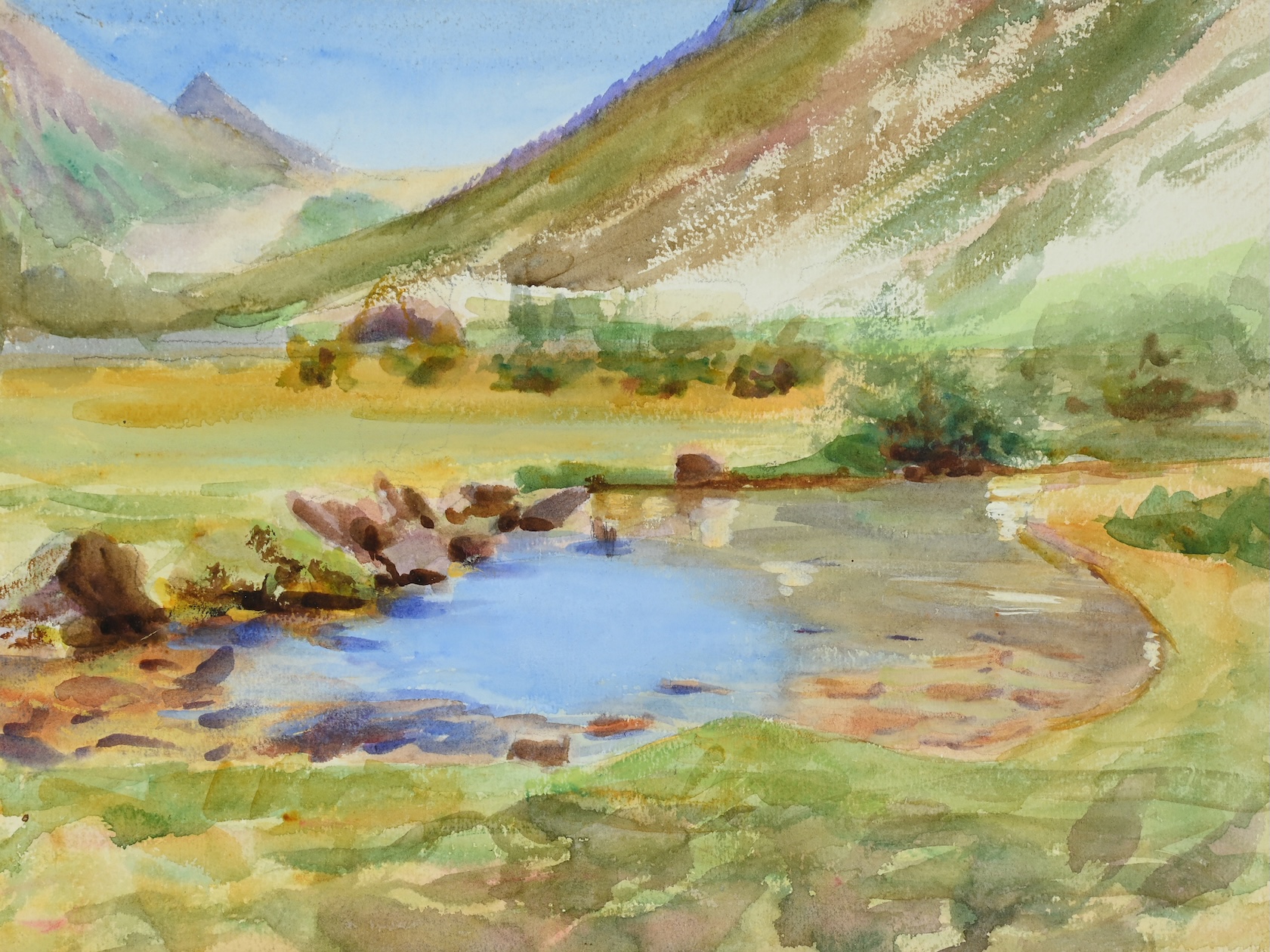
To flick through her bright, attentive works from the early 20th century is to experience her sense of discovery, not only of new landscapes, but also of her burgeoning skill with a brush in hand. One of her talents was knowing how to frame a composition: a desert tree extending its branches beyond page, a boat’s rolled-up sail cutting a diagonal against the horizon. Even in her urban pictures, human figures are sparse and offer scenes scale, rather than character.
Emily Sargent, A Domed Building Tangier (unknown). Photo: courtesy Dreweatts.
In Figures in a Street, Camprodon (1902) such figures serve to accentuate a three-story building gleaming white in the midday sun. More attention is granted to the geometries of architecture, as in A Domed Building, Tangier (1900) that sets a step-shaped structure against a block of cloud. Both works carry an estimate of £3,000 to £5,000 ($4,000 to $6,700) each.
This preoccupation extends to her landscape works, from the careful bend of a Tunisian shoreline to the patterns that emerge in the vivid green of a Sicilian countryside. At times, her works teeter on the cusp of abstraction, such as in Overlooking Granada—estimated at £4,000 to £6,000 ($5,400 to $8,000)—that renders the cityscape in streaks of fleshy pink and pale orange, or in the lone jetty of A Pier, Hammamet, Tunisia—£3,000 to £5,000 ($4,000 to $6,700)—which hangs over a purple sea.
Emily Sargent, Overlooking Granada (unknown). Photo: courtesy Dreweatts.
“Unlike her brother, she wasn’t looking for that important view or to make statement pieces,” Porter said. “She didn’t have the weight of expectation on her shoulders and as a consequence her works are quieter and very personal.”
The works of her brother, which join the sale along with early 20th-century masters like Augustus John, Gwen John, and Harold Gilman, offer a greater range of themes. All the same, the lead lots are also evocative watercolors from his travels.
The first, Constantinople, presents the city’s silhouette in indigo and punctuated with the masts of river-crossing boats. The second, Venice, Gondolas Off San Giorgio Maggiore (1903), huddles up close to a row of Gondolas and offers their reflections on water with deft strokes. Both works carry estimates of £60,000 to £80,000 ($80,500 to $107,300). Elsewhere, there are a handful of the social portraits for which the artist is best known, including an impression of a Thomas Gainsborough painting of a strolling couple accompanied by an exuberant dog. It carries an estimate of £20,000 to £30,000 ($26,800 to $43,000).
John Singer Sargent, Venice, Gondolas Off San Giorgio Maggiore (1902). Photo: courtesy Dreweatts.
Born one year apart to American parents who chose to live in Europe, neither sibling married, though, in some ways, Emily performed some of the duties of a wife. She accompanied John on trips, hosted parties for him, and helped promote and sell his work to collectors. Their younger sister, Violet Sargent Ormond, however, had six children and inherited much of their work after the deaths of John and Emily, in 1925 and 1936 respectively.
Her great-grandchildren are responsible for establishing Emily’s legacy. First came the donation of 174 works to institutions such as Museum of Fine Arts, Boston, and the National Gallery of Art in Washington D.C. in the U.S. and London’s Tate and Oxford University’s Ashmolean Museum in the U.K. Then came a run of exhibitions, beginning with a showing at Cape Ann Museum in Gloucester in 2022, followed in 2025 by a presentation of her watercolors at the Met as a complement “Sargent and Paris,” a blockbuster that traced John’s rise as a young painter.
“The prejudice against a woman being a professional was strong,” Richard Ormond, Emily and John’s great nephew and a leading scholar on the siblings, told Artnet News last year. “Emily was too modest, like many ladies of her time, to think of ever exhibiting or selling her work.” Times have changed.
This article was originally published by Artnet News.