Anne Imhof’s performances can be raw, haunting, vulnerable: see her London show
By Hannah Silver
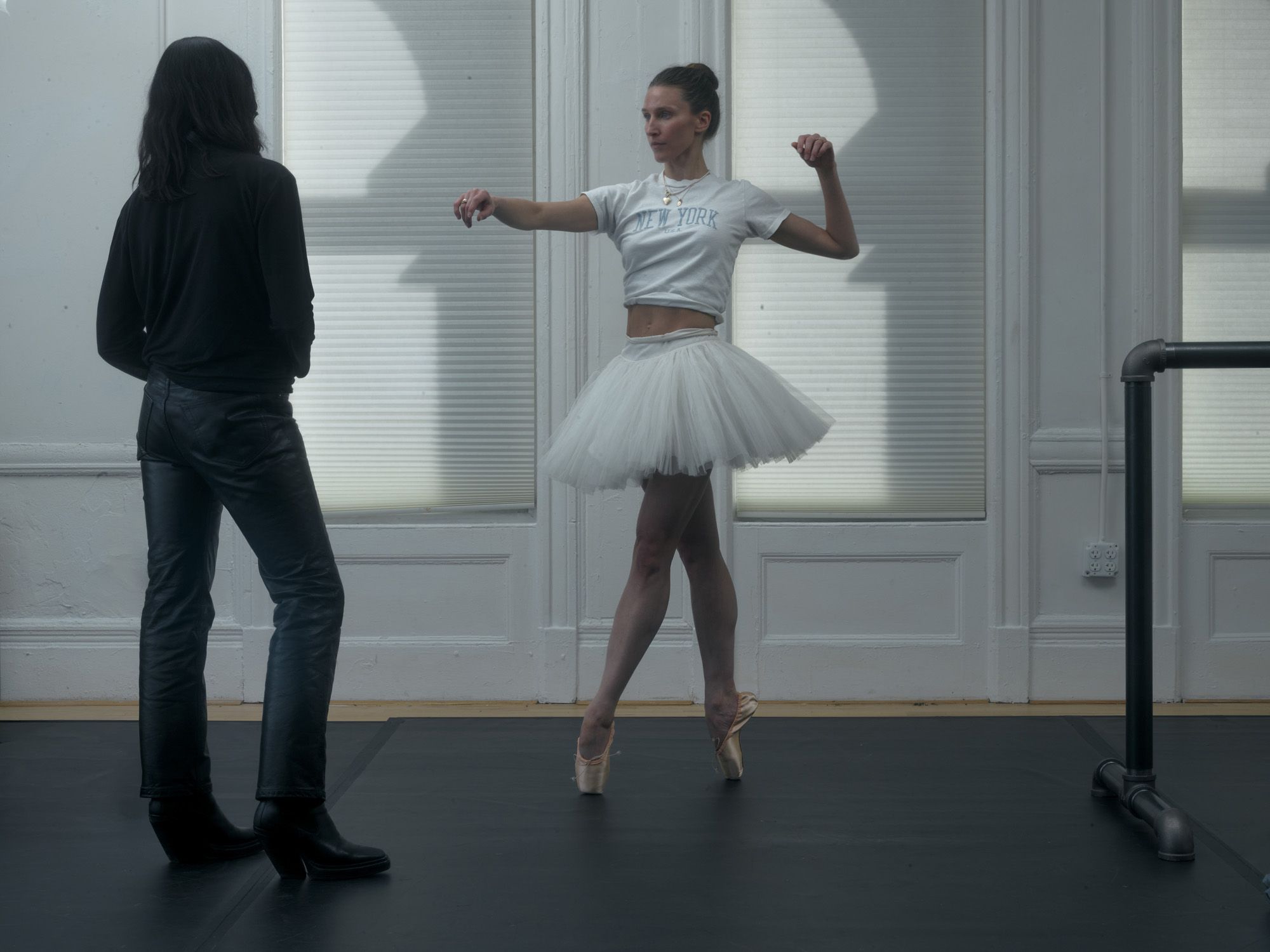
‘The way I work is by preparing myself to relinquish a lot of control,’ says Anne Imhof. ‘The piece is often a performance, and it is in spaces where the audience can walk freely and leave or stay however they please. In taking their own angle or direction on the scene, they almost make their own edit, so there's a lot of possibilities that I think through before the piece is staged, but it's not necessarily rehearsed. But there is this magical moment in all of our minds, the moment where the audience comes in, and this transfer of energy is really palpable. I like it.’
Imhof, a German visual artist based between New York and Berlin, works across an eclectic prism of mediums, from performance to sculpture, music, painting, choreography and installation. In the ephemeral, she finds freedom. ‘The potential of things that can happen, or will not happen, is very potent.’
It is a maxim that has run throughout Imhof’s multidisciplinary, avant-garde and occasionally controversial career. She studied at Frankfurt’s academy of fine arts, Städelschule – although before this, she ‘pretty much home-schooled, through my twenties. I studied art pretty late. It was a very self-determined way of becoming an artist’, she says – and demonstrated an interest in the relationship between music and movement in her first performance. It took place in a bar in the city’s red light district, and she invited two boxers and a band along, instructing the boxers to fight until the music stopped; the band, to play until the boxers stopped fighting.
‘In the beginning, I was performing in my work as the person doing the music – I was playing the concert, and I was close to the development of the movement as well,’ Imhof says. ‘I was trying out the performance movement and working very closely with friends, and I'm still working with collaborators that I started with in Frankfurt. It’s been a long journey in which the collective played a big role, and my detour with music has allowed me to be inside of it. It established a framework that there was a movement done by a performer in relation to me.’
‘The viewer is very important in the storytelling’
Imhof’s performances continue to be defined by this spirit of collaboration, from 2017’s Faust at the German pavilion during the Venice Biennale – for which she won the prestigious Golden Lion for Best National Participation, as well as an Absolute Art Award – to the immersive Sex, first performed over five nights at Tate Modern in 2019, and the compelling Natures Mortes where she took over the entire Palais de Tokyo in 2021.
Imhof’s performances can be raw, haunting and vulnerable, intertwining classical and contemporary references to create juxtapositions also evident in her intimate yet alienated environments, which both group figures together and set them alone. Often held in industrial spaces, they see expressionless performers in leisure wear move past cold materials – glass, steel – in an apathetic retelling of our digital age. Framed as paintings, they play out scenes of isolation from the uneasy perspective of a relentless commodity culture.
Imhof can spend years preparing for her pieces (last year’s Doom: House of Hope at New York’s Park Avenue Armory took three years of development), yet, ultimately, instinct drives them. She cites an early experience as key in defining her practice: ‘In the past, I prepared for pieces by trying out a movement in public; there was no rehearsal space, we went outside and tried out scenes. Once, in Paris, we performed a tiger-like roar piece on all fours, crawling through open spaces. I went with somebody who was taking photos, because I wanted to see how it looked. I wanted to become an image. It was like taking your strength back.’
Receive our daily digest of inspiration, escapism and design stories from around the world direct to your inbox.
‘The video work [is] very much about movement, and also about me having brought ballet into the work’
While Imhof’s work has always been multidisciplinary, recently there has been a shift from the ephemeral to the non-ephemeral. Earlier in 2026, at the Serralves Museum of Contemporary Art in Portugal, Imhof presented her first outdoor sculpture. Steelbath (2025) a water-less swimming pool in grey steel, is a dark and subterranean void. Inside the museum, hours before the exhibition opened, Imhof applied horizontal scratches to her paintings, creating a newly visible and more abstract layer.
Imhof will build on these themes with her London exhibition, ‘Citizen’, at Sprüth Magers (5 June – 1 August 2026). Here, new figurative oil paintings, with scratches, will join a film, site-specific sculpture with drawings, and bronze reliefs depicting tender scenes between women. ‘The video work derives from the performance piece, Doom. It's very much about movement, and also about me having brought ballet into the work,’ Imhof says. ‘In the paintings, two ways come together, in the more gestural and movement-based painting that I do, and then the figurative painting – they became one on canvas. For me, it was the new thing that happened in Serralves, opening a whole new way of combining the abstract with the figurative.’
It is a natural culmination of her life’s work so far, Imhof reflects. ‘If I'm interested in the discipline that systems have on us and how that manifests in an object, then I always like thinking back to a very early series of self-portraits,’ she says. You can’t really see her face in those black and white photographs, she adds, but you can see the boxing gloves she is wearing. ‘For me, it is the idea that what I present in the end might be the thing that I've dealt with, more than it is my interest in showing it. The thing confronts the person in front of it. The viewer is very important in the storytelling, around my work and around the shows.’
‘Citizen’ by Anne Imhof is on show 5 June – 1 August 2026 at Sprüth Magers London, spruethmagers.com, anneimhof.com
This article appears in the July 2026 Issue of Wallpaper*, available from 4 June in print on newsstands, on the Wallpaper* app on Apple iOS, and to subscribers of Apple News +. Subscribe to Wallpaper* today
Hannah Silver is a writer, editor and author with over 20 years of experience in journalism, spanning national newspapers and independent magazines. Currently Art, Culture, Watches & Jewellery Editor of Wallpaper*, she has overseen offbeat art trends and conducted in-depth profiles for print and digital, as well as writing and commissioning extensively across the worlds of culture and luxury since joining in 2019.
This article was originally published by Wallpaper*.