Emma Copley Eisenberg Wrote a Book Designed to Create Friction in a World of A.I. and Ozempic
By By Emmeline Clein
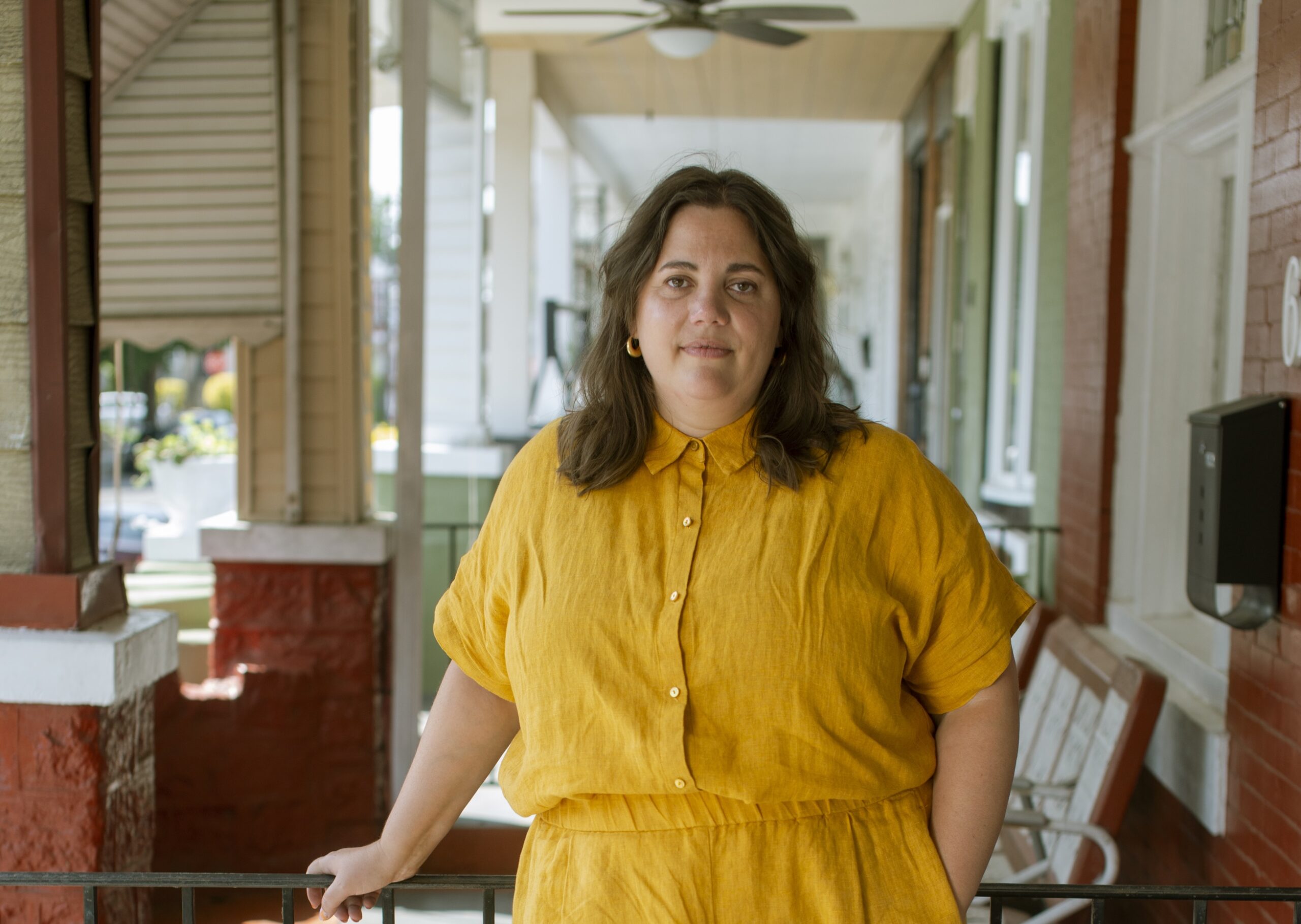
A recovering girlboss moves to the countryside; a set of depressives attend an embodiment summer camp; a woman reckons with the viral revenge porn video that ricocheted through her adolescence. In Emma Copley Eisenberg’s new collection of interlinked short stories—or perhaps more accurately, her slinky almost-novel—bodies expand, contract, recess, and, eventually, reach for each other.
Eisenberg is the author of one novel, a narrative nonfiction book, and the Substack Frump Feelings, where she offers craft advice alongside brazen, knife-sharp criticism of the insidiously fatphobic currents running through canonical literature. With Fat Swim, her first foray into short fiction, she tenderizes her prose and presses her pain points, affectionately nursing a set of shared elder millennial wounds around fatness, queerness, and growing up on the internet.
Meanwhile, on the periphery of I-95 in real life, a cobalt-blue billboard startles a cloudy sky. A torso is obscured by pool water, chlorinated neon. Skin drapes and ripples, simultaneously blurred and spotlit by the transparent liquid. Thick, rounded letters announce that YOUR GUT IS A TERRIBLE THING TO LOSE. Instincts, cravings, sudden yearning, the pinch in your stomach at the sight of freckles scattered just so across someone’s face. The billboard riffs on the iconic phrase “your mind is a terrible thing to waste,” indicting the collective sacrifice of our appetites, natural forms, and bizarre predilections before the altar of Ozempic-induced, numbed-out conformity. It also winks at the cultural and intellectual losses we are racking up at the pixelated hands of artificial intelligence. Eisenberg funded the billboard using money from a class action lawsuit against A.I. giant Anthropic, which trained its chatbot Claude on literature, including her 2025 journalistic outing, The Third Rainbow Girl, without compensating or getting consent from authors.
Much has been written about artificial intelligence interrupting our conversations, siloing our discourse, sneaking into our literary magazines, and hastening our descent into a miasma of ennui. Our intellectual horizons are narrowing as our bodies slim, and as an uncanny congruency comes for our faces. Natalie Adler recently described this new status quo as “smoothing out the American body, face, and mind.” Might we be sliding down a slippery slope into the frictionless existence Big Tech sold us? People have begun to notice that it might be less a promised land than a quarantine unit riven by loneliness and illiteracy epidemics (not to mention a Gen Z sex drought).
Ozempic users increasingly report their experience with the drug as defined by an extinguishing of desire and pleasure alongside the suppression of hunger. Allison Davis recently pointed out that, in the “pleasure-free purgatory” of our DoorDash-ridden gig economy, “maybe it doesn’t matter so much” to give up intense feeling in favor of “GLP-1-induced anhedonia.” Some people, on the other hand, are taking frictionmaxxing out for a spin. Fat Swim—rife with colliding plots and characters whose bodies are marked by fissures, scars, and folds—can be read as an experiment in increasing friction. I certainly don’t know how we can love each other without the irregularities and divots that function as footholds, the crevices into which we pour our care and desire.
As Fat Swim hums to a close, Eisenberg investigates the body in question: hers, yours, mine. The narration switches suddenly from third to first person, becoming a syrupy, sensuous recitation of the substances, spaces, happenings, and people that forged the author’s current physique.
Earlier this month, Eisenberg and I met to discuss the desire for grief, disordered eating, and comic survival.
You wrote a collection of linked short stories—was that form itself informed by your literary critical writing around fatphobia in literary novels? I wondered whether this elliptical, constellated form allowed for folds and puckers of sensory experience, plot arcs, and character development that a traditional, linear novel couldn’t hold.
This book took me 12 years to write. I lost faith in fiction, in what a story was, for a time. My perspective felt so far from the cultural system of the MFA that was telling us what a story was, particularly around the question of: what role does a body play in literary fiction? My professors were forging a feminist response to dirty realism. Their response was to say, the body doesn’t belong in literary fiction. The body belongs to the domain of hack, schlock, romantic fiction. I think there’s something about the body and something about a large, unruly, strange, monstrous body—which could be the fat body, which could be the trans body—there’s something about that body that does not work in linear literary fiction as I was taught it. I had to figure out why, and break the form. These stories could not be a novel, and they also couldn’t be discrete short stories. There is something recurrent.
That reminds me of the moment one of your characters muses that they’d “lost the word story, and am only now getting it back.” You’ve spoken about writing out of spite towards literary legends like Jonathan Franzen, whose work contains moments of startlingly severe fatphobia. But as I read this collection, spite didn’t quite feel capacious enough to capture your affect. It felt like you were writing out of spiteful care, or grieving desire?
The less grounded in a truth we are, the more we have to write about it. I certainly did not come to a place of feeling that my own body is not made of trash until very recently. Reviewers have framed this book specifically around fatness, and while largeness, space, and corporealness is core to what I was interested in, I don’t necessarily see it as a book that’s about fat people, per se. Take the story “Ray’s Happy Birthday Bar,” which is about the trauma of giving up a kid for adoption, of what it feels like to be a halfway mom when other people are all the way moms or not moms. It’s about a toxic relationship between an ostensibly straight person and an ostensibly queer person, and their bodies being charged for and uniquely drawn to—but also quite repulsed by—each other. I like the idea of spiteful care, of longing for grief. It’s also a story about self-destruction and the ways that we bring the people that we love down without meaning to.
One of your characters likes the word “untenable,” because it doesn’t mean impossible, but “impossible to hold onto with your hands.” Untenability felt really evocative of your book’s core questions. What happens in the in-between, the liminal periods of our lives? What happens to our discarded desires, the ones that still haunt us?
When I was in Chicago for an event, the coordinator of the bookstore, Women and Children First, brought me two cakes. They said, “I noticed that the phrase, ‘you can’t have your cake and eat it too,’ comes up twice in the collection.” It was sweet, but also quite profound. What if we could have multiple cakes? And eat them at the same time as we’re making art about not eating our cake! The story form allows for a multiplicity that a novel wouldn’t. That multiplicity is key to what I was wrestling with, and in no way solved. I don’t think any of the characters solve it in this book. The character you quoted is talking about wanting something that isn’t articulable. I wrote to Kristin Dombek’s advice column at n+1 back in the day, with a question about bisexuality. She said, the problem of choosing, that’s the problem where we all live. I was talking specifically about queerness, but she was really thinking of it in a philosophical way. That’s hopefully how my characters approach it. It’s a how should a person be question. By choosing one thing, you lose another thing. In linked stories, you get to see people over time. That character comes back in another story, and essentially, that story is about saying, I can retell a story in a new way and retelling it doesn’t solve the problem but it better articulates the problem.
Your stories are dispatches from reckonings, often set in swampy moments of confusion. Some are doubly narrated—by an anguished, often cruel, internal voice and by a version of the narrator able to re-describe the same events in a vocabulary that renders their life not just livable, but amusing.
We’re in conversation with that voice all the time. I didn’t realize I had that voice in multiple stories until a couple people pointed it out. The voice that tells you you’re ugly. Something I’m really interested in is beauty. People think of beauty as moral. If you’re beautiful, you’re assumed to be good. What I was trying to unpack was: what if I’m not beautiful and not good? At one point, a fat character, who was once thin, says, “You can’t tell me that a thin person and a fat person aren’t people in two entirely different stories.” The world will tell different stories about you, and that’s really interesting to me.
The children in this book have such poignant conceptions of beauty, ones we are tragically taught to forget as we age—kids bring a childlike wonder, an ability to find our physical forms attractive, sure, but better yet, bizarre, thrilling, funny, sensually and sensorially intriguing but not in a straightforwardly sexual sense. These young characters remind us that the word “beauty” can be used in far more ways, and situations, than adults might think.
I love that. In Fat Swim, a child touches someone’s leg hair. I’m not trying to make a statement around whether people should or shouldn’t have hair there, but it’s a kid seeing it and realizing, oh, this is an option, this has a texture and a sensory input and this hair is interesting. I thought a lot about kids and the ways that kids are always looking at adult bodies and wondering, am I like that? Am I not like that? In childhood, you’re so unfree and your body is so present. It’s intense. I think we don’t talk about that enough. In a lot of literary fiction, the only way we get to see people’s bodies and be touched is in a sexual context, which is strange. In this book, there’s a character who goes to Sex and Love Addiction Anonymous. For a lot of folks, having sex and eating are the basic ways we understand that we have a body. A lot of people have glorious and interesting and open experiences with sexuality in these stories. But in a couple, people get stuck because sex is their only way into being embodied, and that can become a problem.
At one point, someone wonders, jokingly, whether anyone has ever died from living in a contradiction. They were talking about something geopolitical, but it related, to me, to your treatment of disordered eating. People suffering disordered eating often encourage each other to adopt dangerous habits. You treat the issue both starkly and delicately, rendering that phenomenon without blaming anyone, or casting the disordered eater as malevolent.
There’s a moment, after the protagonist of one of my stories is given a buyout from her co-founders because she’s not thin enough to be one of the faces of their company, when one of those friends says, try running, I do that. I don’t think that anyone who’s restricting and in the grip of the will to thinness is choosing. They’re in a system. That system produces very strange and idiosyncratic bodily management techniques. She’s talking about a coping behavior. She’s thinking, I have to diminish and squash down any feeling I have about being embodied.
Right, she thinks she’s helping her friend by offering her this self-harm strategy.
Exactly, she’s like, here’s my tip for you. I’ve experienced that, and it feels shitty. But I don’t see any of those characters as villains. I don’t see any character in this book as a villain.
You write that fat “is not all softness. It bounces. It bounces back.” There’s a buoyancy to your prose, a bounciness where one might expect an existential weighing down—basically, a humorous strain that runs through even the most dire psychological straits your characters find themselves in.
One of my main goals in writing now is to be funny. I’m interested in an approach to living that has buoyancy. I have joked that in fiction there’s the Ottessa Moshfegh-to-Grace Paley spectrum. Moshfegh thinks all her characters are disgusting and morally bankrupt, and Paley thinks all her characters are beautiful, sanctified, and cherished. There’s immense value in [both]. It’s a matter of taste and preference. As a reader, I prefer to dwell in the side of the universe that is interested in cherishing our characters. Not that they can’t be compromised, not that they can’t hurt each other and make poor decisions, but there’s an inherent humaneness in every creature. When you start to attune to the sensory nature of life, it’s so bizarre and strange. I try to find the humor in the bizarreness of everyday living.
Right, and that humor is at the core of the really inquisitive orientation of your narration.
A friend said it best: she said, whenever you tell a joke, the audience’s belly is exposed. And then, when you slam them with an insight or with sadness, it lands all the more deeply. This is kind of a violent metaphor, but there’s something about your belly being exposed that I think is very useful for fiction writing. I’m not going to murder my readers, but wound them in a way that I hope sticks.
You’re just giving us a nice little stick and poke tattoo. Speaking of bellies, you rented a billboard to advertise this book, which featured a stomach underwater, and the phrase “YOUR GUT IS A TERRIBLE THING TO LOSE.” Where do you see literature headed in the Ozempic era?
It’s been surprising to me how many people have been excited about the body neutrality ideas in Fat Swim and on the billboard. A couple of years ago, I wrote something for a big Philly outlet and when it was posted on Instagram there were thousands of comments that said things like fatty go die. This time, there was still that, but there were also a lot of people saying, this is a cool image. This is interesting.
In literary land, I’m not as hopeful as I could be. It has so much to do with class and what we want to believe about what literary fiction is and who the intended reader is. If we imagine the intended reader of Pulitzer Prize-winning literary fiction to be a fat person, there’s something that breaks in people’s brains. Many of my friends are on GLP-1s, and that will probably be true for a long time. What’s more interesting than the question of whether GLP-1s will last is: are we going to continue to believe that the only bodies that matter are “healthy” ones? I’m drawing from disability justice movements that question the idea that a body has to be healthy in order to be valuable. Is that going to be the case in a world where all of our bodies are breaking down, when the planet itself is breaking down?
Can you tell me one thing
This article was originally published by Cultured Magazine.