Watch Out Montauk, Some California-Sized Art Is Coming Your Way This Summer
By By Karly Quadros
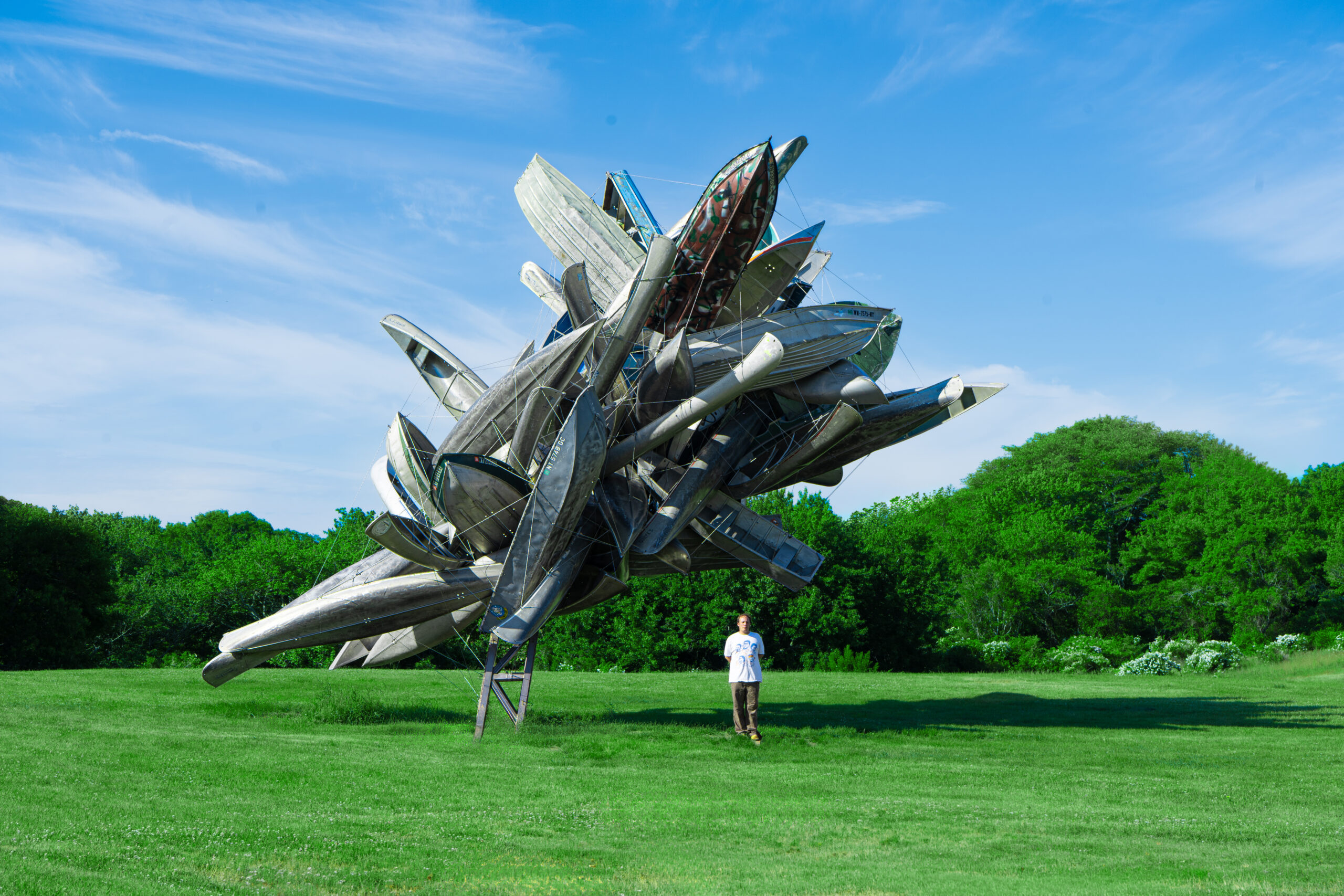
There are only three works in the Ranch’s summer show, “LA Monumental.” But as the exhibition’s title suggests, you can’t miss them. Sculptures by the celebrated Los Angeles–based artists Nancy Rubins, Paul McCarthy, and Matt Johnson tower like carnival rides over the expansive outdoor gallery-cum-horse farm in Montauk.
The artists, ages 47 (Johnson), 73 (Rubins), and 80 (McCarthy), share an interest in mining nostalgia for inspiration and realizing their visions on an epic scale. (Hamptons-based crane operators had their work cut out for them.)
Rubins—who is known for creating blooming, unwieldy spirals of cast-off objects from hot water heaters, televisions, and airplane parts—teamed up with the Ranch founder Max Levai to source decommissioned fishing boats in Montauk for her new work, a spiraling totem titled Friends of Pluto. Johnson, who also uses everyday materials to create witty sculptures, assembled an array of shipping containers into a stick-figure giant sitting pretzel-style on the ground, Meditating Figure. Finally, McCarthy presents Sisters, a massive bronze featuring bizarrely twinning figures from his long-running body of work inspired by Snow White.
The artists may be best known for working in expansive LA studios, but their ambitions are right at home in Montauk’s wide-open spaces. Ahead of the show, they ruminated on the paths that led them there. —Julia Halperin
“I was a student in the early part of the ’70s. At that time, my financial resources were slim, but I had good imagination and a lot of energy. Not only could I not afford oil paint or bronze, but I really didn’t have any interest in it. Instead, I was aware of these marvelous shapes that were being disposed of: used coffee cups. I started amassing large quantities of these. Being that the Vietnam War was going on, the school had access to an Army Surplus store where we could buy huge canvases for very little. I began making large configurations with these surplus canvases, refuse cups, and the wet mud clay in the slurry bucket at the ceramics department. The work was highly temporal: when the clay dried, the work was complete, and I then disposed of it. I realized that it was not only important to develop a form that transcended its original materials and became something completely different—the sense of time, imbued in the object, was very important to me.
Once I got out of school, I began accumulating massive quantities of objects that were compelling to me. I had no real yearning, especially to build the monumental—the work demanded to be huge. Over time, the elements I worked with and my form of working evolved. However, the reflection of time and the object’s transcendence have been a continuum. Over the recent years, I’ve been working with materials like scrap airplane parts, hot water heaters, trailers, children’s playground equipment, and boats. And I had been catching these objects at their cusp, right before they were to be melted down to become another object.
I began buying airplane parts many years ago from a gentleman named Mr. Huffman for 10 cents a pound. During my friendship with Mr. Huffman, he would show me images of him in the National Geographic from right after WWII with a mobile smelter that he had designed and took around the Southwest, melting down the war fleet. Years later, a gentleman who I had been buying metal elements from for many years brought to me a series of aluminum cartoonish spring animals that were made for children beginning in the late ’40s and early ’50s to ride outside of shopping centers, parks, and playgrounds. At this moment in time, these toys were deemed unsafe and were being removed from the playgrounds. I wasn’t sure how to approach them. I was thrown off by their figurative nature. I have always avoided overt figures. I tend to think the figure is implicitly in any and every object we make. But I realized that, en masse, they could become abstracted forms.
Then I realized that these were the airplanes that Mr. Huffman had melted down in the Southwest. These spring riding toys were produced immediately after WWII, and the baby boom took off. I started thinking about the long history of the objects: what they were before they were airplanes, what they were before they were any object at all. Aluminum in the Earth, and, before the Earth was formed, particles in space. As my work has evolved, the sense of transformation of the materiality of the objects and my own understanding of time seems to be a continuum. In the most recent work that I just finished at the Ranch, Friends of Pluto, which consists of used and reused smallish aluminum boats held together with stainless steel wires, one can get a simple education of physics and time.”
“My childhood house was built by a contractor from California who went broke, so the subdivision was only three streets in the middle of nowhere. If you went out the front door, it looked like The Truman Show. Out the back door, there was nothing for a few hundred miles.
I couldn’t get into a university because my high school grades were terrible, so I ended up in this agricultural school. I ended up meeting a number of really interesting students and teachers, which might seemunusual, an agricultural school in the middle of nowhere. Then I went to at the University of Utah. Theart department was really political. This is ’65 to ’67. The Peace and Freedom Party had been formed, so I ended up in this environment in Utah with a number Marxist teachers, encouraging students to make experimental and conceptual films. Then all the young faculty were fired after about two years, and everybody who was hip in the school dispersed.
Through San Francisco, Utah, and then when I moved to LA and went to school [at USC], I didn’t think much about galleries. I ended up teaching at UCLA because of Chris [Burden, who taught in the art department until 2005]. I don’t think any other school would have hired me. I actually never sold a work of art till probably ’91 or ’92. I was never really interested in New York. I carried a key chain that said ‘I Love New York’ for about 10 years and never went there.
Sisters was a sculpture I made in 2013. I made one Snow White, but really abstracted. At one point, I decided I didn’t like the direction it was going, but I didn’t want to change the one I’d already started, so I started to make a second one. Then I realized I could put them together. All the way back to the ’60s, I’ve stacked things. The drawings are often of stackedimages, heads, bodies, forms. A lot of sculptures are stacks. It’s something I’ve known about my work for a long time, in a kind of totem sense. Even with all the solo shows I’ve done in the last couple of years, I’ve mixed two or even three bodies of work. They play off each other even though they’re sometimes separated by 10, 15 years.
At this point, I’m not making many monumental figurative sculptures anymore. The big pieces I’ve made are the big sets that I’ve shot films in. There’s one 18,000-square-foot room in the studio that has six or seven of them. A lot of the work now is monumental in a digital sense. I’ve probably accumulated a few million photographs or images and terabytes of videos. It’s to the point that you can’t show it in any conventional format. I remember once sitting on a panel with Chris, and he said he only needed one photograph for a performance, and I said I needed a thousand. It was a joke, but there’s something about frames and film in relation to action or time. With A.I., it’s so much about acceleration. You can make a thousand images with the snap of a finger, so there’s some kind of uselessness about what I’m doing. It’s dysfunctional by its nature.”
“I was always building and experimenting with things, both in painting and physically with objects. I only ‘discovered’ sculpture through working in art school. I found myself wanting to learn how to work with tools and how to make molds, cast plaster, and learn to weld. When I was in college, I had a cousin whose family had a barn that his father had turned into a crazy house, with lofts and bridges and triangle windows. It made an impression on me as this indoor-outdoor space that was creative and malleable. That expansive space in a semi-rural setting offers, I think, freedom—having space to have shipping containers lying around. If I were in a smaller space in the city, I might not have made that creative connection.
Even when I had studios in the city, I’ve always collected stuff and made work about the things that exist in my environment. One thing that I did in Baltimore—which I think was inspired by Nancy’s work because I’m pretty sure I saw images of her stuff in magazines—I collected all these tires, from around the city, and I piled them all up in the oldest building at MICA. It’s an old classical building with marble floors like out of the Gilded Age, with a cascading staircase, and on either side, they have these replicas of these Greek statues from the Acropolis. I installed it all in the middle of the night, so it was a complete surprise to everyone. The whole place smelled like rubber. I started to work outside, and the city started to become my studio. I started doing these, as I called them, subtle interventions, but they were really just going around the city and making mischief.
Around 2019, I started experimenting with different sculptural compositions using bricks, cinder blocks, and scraps of rebar—cheap construction materials. I had some shipping containers at my studio that I was using as storage spaces, and I started to look at them as just big bricks, like Legos that could be used to compose a large sculpture. I started to think about what the containers themselves represented. They are vessels that relate to us humans, but they are also filled with goods for trade. They represent capital. They are shells and beads for trading. They are like a pile of coins. Sculpture is often comprised of resources: a block of stone, a lump of clay, or scrap metal to be melted down and recast. I use them like bits of data, pieces of a whole, like stones in a wall or two-by-fours in a house, or lines of code in an algorithm. This sculpture [at the Ranch] has essentially traveled around 12 million miles at sea before it was retired. That’s like traveling around Earth 500 times.”
More of our favorite stories from CULTURED
Sienna Spiro, Your New Favorite British Belter, Loves It When a Musician Puts Her in Her Place
‘House of Criticism’ Is for Fans, Not Critics: Johanna Fateman on the Jerry Saltz and Roberta Smith Doc
The Stars of Art Basel: Four Artists Having a Moment on the Fair Floor
15 Must-See Gallery Shows on View in London This Summer
How Chef Julia Turshen Cooked Up the Season’s Spiciest Queer Romance Novel
Sign up for our newsletter here to get these stories direct to your inbox.
Sign up for a digital subscription, starting at less than $3 a week.
Sign up for a digital subscription, starting at less than $2 a week.
You’re approaching your limit of complimentary articles. For expanded access, become a digital subscriber for less than $3 a week.
For less than the price of a cocktail, you can help independent journalism thrive.
For less than the price of a cocktail, you can help independent journalism thrive.
You’re approaching your limit of complimentary articles. For expanded access, become a digital subscriber for less than $3 a week.
For less than the price of a cocktail, you can help independent journalism thrive.
Support independent criticism for $10/month (or just $110/year).
This article was originally published by Cultured Magazine.