A Natural History of William Kentridge’s Studio
By William Kentridge
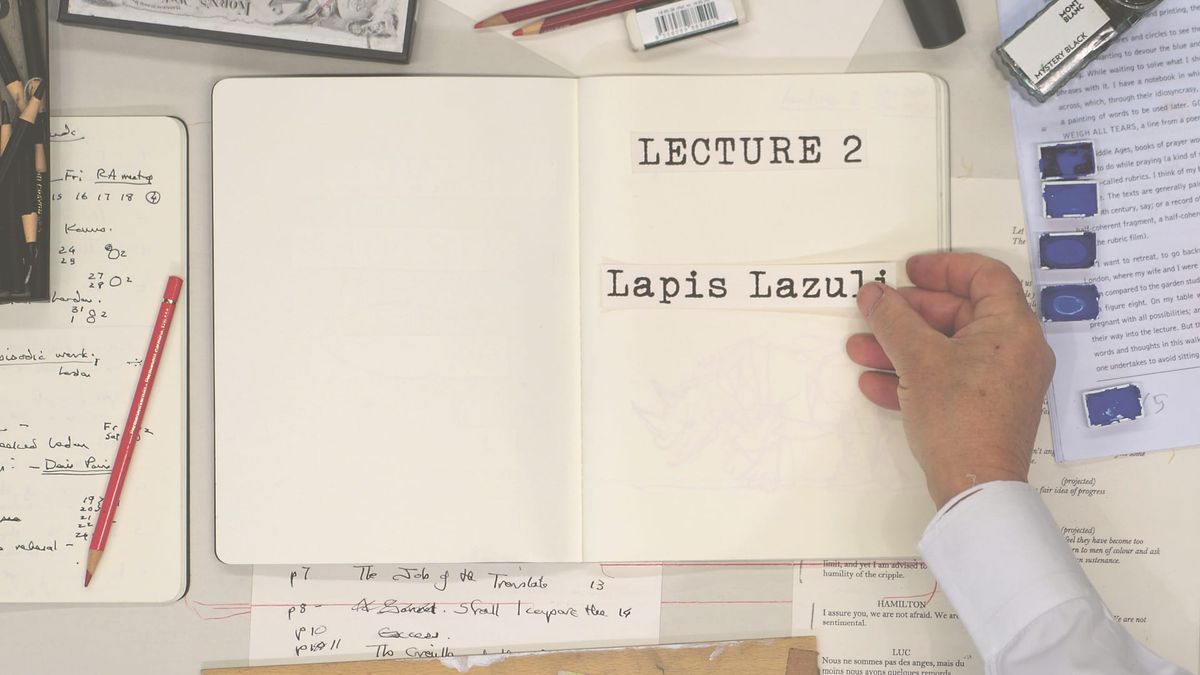
Editor’s Note: The following text is a chapter titled "Lapis Lazuli" that has been excerpted with permission and adapted from A Natural History of the Studio (2026) by William Kentridge, published by Grove Press and available online and in bookstores. The book gathers the Slade Lectures delivered by Kentridge in 2024 at the University of Oxford.
Some years ago, two friends gave me a block of watercolour, pure lapis lazuli from Afghanistan. Lapis lazuli is a precious pigment used sparingly in Renaissance painting, now more generally replaced by French ultramarine. But there is an intense blueness in lapis, a colour coming off the paper towards you that is unmatched by any synthetic colour. In projections and photography and printing, this blue always loses its power.
I don’t use colour in my drawings. But I painted some squares and circles to see the colour I was given. I was caught, wanting to devour the blue and not knowing how to bring it into anything I was drawing. While waiting to solve what I should do with the blue, I started painting texts and phrases with it. I have a notebook in which I write down phrases or sentences I have come across, which, through their idiosyncrasy, or particularities, feel they need to be held, put into a painting of words to be used later.
GOD’S OPINION IS UNKNOWN, a Setswana proverb.WEIGH ALL TEARS, a line from a poem by Czesław Miłosz.YOU WILL BE DREAMT BY A JACKAL.
In the Middle Ages, books of prayer would have both the words of the prayer and instructions on what to do while praying (a kind of stage instruction). These were painted or printed in red ink, in so-called rubrics. I think of my blue texts as rubrics, something at the edge of discursive language. The texts are generally painted on the pages of old books: religious texts from the eighteenth century, or a record of stargazing from Cape Town in the nineteenth century. A half-coherent fragment, a half-coherent thought, on top of a considered older thinking.
THE OLD GODS HAVE RETIREDYESTERDAY’S GOOD IDEASTRUGGLE FOR A GOOD HEARTA BOX OF SHAMEHISTORY ON ONE LEGFIND THE LESS GOOD IDEARECREATIONAL DANGERA SAFE SPACE FOR STUPIDITYDEFENSIVE SLEEPINGTHE PLEASURES OF SELF-DECEPTIONENOUGH AND MORE THAN ENOUGH
I am interested in coherence and incoherence. The limitations of coherence, and the productive possibilities of incoherence. The irresistible pressure to find coherence and avoid the anxiety of incoherence. I am caught between needing a manageable progression of thought and argument, and a wish to allow the fragments to fall where they may. To demonstrate literally the panic inside our rational movement through the world.
But I want to retreat, to go backwards. The start of this lecture was written in my flat in London, where my wife and I were isolated in COVID quarantine. The studio in the flat is a small room compared to the garden studio in Johannesburg: forty-two paces to circle the studio if one walks in a figure eight. On my table were my notebooks, waiting for words; a full fountain pen, pregnant with all possibilities. But the chair resisted me. I walked around the studio, gathering the words and thoughts in this walking (2,400 steps, according to my phone) – all the small tasks one undertakes to avoid sitting down.
There is a kind of Ur-language. Testing some phrases in my head: “Some years ago, a friend gave me a block of lapis lazuli . . .” “Lapis lazuli is the brightest . . .” “I have never seen a blue as bright as . . .” Phrases or sentences, but more than that, a sensing in the muscles. Somehow in the pectoral muscles, in the tastebuds, a move and a tensing, trying to pull the different thoughts together. Holding on to a thought the way one tries to hold on to a dream as you wake. The thought was there, a clarity. Ah – now it is gone. Talk about the lapis blue, then about the periaqueductal grey. As I pace the desk, I write “lapis blue – periaqueductal grey.” One part of my head repeats, start with the lapis. The other part is off on its own journey: “Mr. Leopold Bloom ate with relish the inner organs of beasts and fowls.” Where did Ulysses come from, out of the blue? A glance at the table, notebook still untouched.
My thinking is stopped by watching myself walking, and writing. To will a coherence for thought. The unmoving me at the centre of the room instructs the other self, circling like a circus horse trotting around the ring at the end of a rope. Talk about the words, I instruct myself.
Translation. Tell them about translation in the studio, about the Markov blanket, about images, from ink to sound, sound to ink to colour, about Kurt Schwitters’ Ursonate. Check the date of Ursonate and Ulysses. I run out of thought. Now start. I don’t.
Maresfield Gardens in Hampstead. The great secular rabbi Sigmund Freud. No, no. “You are just avoiding the book and the pen.” Jewishness in Englishness was the previous lecture.
I write down “procrastination.” I write down “productive procrastination.” Then it finally begins, the first words on paper addressing, in this case, words.
This split of the self, one self walking around the room trying to will a thought or series of thoughts into coherence, whilst another voice, another self, admonishes them for the inadequacy of their efforts, is a common sensation, particularly in the studio.
There is the artist as worker, charcoal drawing, close to the paper. And then as the artist steps back a pace or two to see how the drawing looks, a second self emerges, the critic, who sees at once the weaknesses or mistakes of the work on the wall and sends the first self back to the drawing with a series of instructions (move the horizon down, the cloud is too dark) or admonishes, “How can you still get it so wrong after so many years?”
Language, or language in the studio, is the subject of this second essay. Language – of course, using language to discuss the studio; but also, the processes of the studio: to think about language, the translation from word to lapis lazuli; about the colour, but the colour also changing one’s sense of the words. The studio is a place of making, but also a place of making meaning. It is a space and a technique of translation. It starts with blankness, with incoherence, the blank sheet of paper, the words on the paper, hoping they will lead to a coherence, or at least to a provocative incoherence. If the drawing is the finished sentence or the paragraph, then the process of making the drawing can reveal the invisible process behind the spoken or written word. The faster-than-one-can-write, or think, following the processes of our unconscious brain, gathering the fragments, then sending them out through the muscles of the chest, the throat, the larynx, the tongue and the lips into the world. The words come before realising what we are going to say. “Did I just say that? Not me. I would never say such foolishness. If I was in charge of my words, they would be so much more persuasive.”
This is all slowed down in the studio. The drawing is the thinking before the thought is conscious. The walk around the studio is the preamble even to this.
There is a dispute in neurology as to where the font of consciousness lies. Conventional wisdom has it proceed from perception outwards, the gathering of information about the world, which transforms eventually into awareness of the self, seeing many birds in order to understand bird-ness. But there is another theory that feels much closer to me. Consciousness, this line of argument goes, starts not from the frontal lobes, the most sophisticated part of our mind, but from the periaqueductal grey, a pea-sized piece of grey matter at the brain stem, the most primitive part of our brain, a highly sensitive piece of the body. One side registers pain; the other pleasure. This is the periaqueductal grey. It moves towards and away from the world; towards warmth if we feel our temperature drop; away from the burning heat, if you’re too close to the fire.
This is miles away from rational decision-making. This is the body thinking. There’s an impulse, which will find its meaning later. First, a phrase and later an analysis of what it might mean. Consciousness comes from emotion, desire or repulsion. First, a drawing, and only afterwards a questioning: What does this drawing say? An impulse to make that is prior to the “what” that is made; what the subject is. The pull of the studio is central; the “what” is much less so.
It could be a text, a tree, a drawing of a coffeepot. They are all translations of a much more primitive desire to send something out into the world. This is both me and not me. Something I have made, but which is also more than me. I leave, the drawing remains – a shadow one can leave behind, or a snail trail of the passage of one’s life. This is knowing our edge but working to reach through it.
We construct a Markov blanket, that membrane that defines where we end and the rest of the world begins, the edge of what we can protect against entropy. It is the job of the artist to resist entropy. This metaphoric blanket is not the outside world, but it is sensible to it, and sensitive to it, a membrane of negotiation between that which comes towards us and how we meet it. This blanket is a borderline for all life, for an amoeba, a jellyfish, a human, each resisting their private entropy. Something between us and the world.
In the studio, a drawing will stand in for this membrane; something marking the border between us and the world. This is of course a great simplification of neurology. One must understand the artist as scavenger, half-digesting other people’s thoughts, taking scraps into himself. What is important here is the nourishment provided, the productivity of these metaphors, not their scientific correctness. In this case, I am held by the image of that unreachable centre in our brain, thought circling it. And of the Markov blanket, not as a statistical proposition (which correctly speaking it is), but as a felt blanket draped over
our shoulders, under which all these thoughts and impulses can churn unseen.
There is a blindness under the blanket, a stupidity. Let it be said, the studio is a safe space for stupidity. A space where impulses can be given the benefit of the doubt. Freud referred to the psychoanalytic space between the analyst and his patient as a Tummelplatz – a place of tumbling or jousting, a terrain for allowing anything to be said, understanding that there may be a sense to unearth in the flow of images and thoughts that emerge in a stream of consciousness, allowing the unconscious to bubble to the surface. The studio is a Tummelplatz, the artist both patient and analyst; the sheet of paper the terrain on which this jousting takes place. Follow the line, follow the lie, follow the image, and discover who you are.
The translations are numerous – swipe across the paper – a horizon line. This is both an impulse, a sweep of the arm, and the thought dividing the paper, sky and earth, the start of the
map. Here is the world, here is the continent, the field in which I place myself (understanding that, in the end, each drawing is a fragment of a self-portrait). So, the translation from impulse to image. This is what it makes me think of: a horizon, so a landscape, the vertical charcoal marks become interventions in the landscape, short lines become the winter stubble of grass after a veld fire to the south of Johannesburg. Looking at the drawing, 10 percent is the optics of seeing the marks, the lines, the grey smudge of the charcoal; 90 percent is predictive, associative, memory.
The drawing touches the original, the veld outside, but only tangentially. The translation always touches its origin, or its source, like a tangent to a circle.
But even when translation seems closer, more direct, there is a transformation. A mimesis, the most accurate copying of the real original into an artificial form certainly has its pleasures. A trompe l’oeil drawing of an object, painted with such fidelity that your hand reaches out to touch it. A pencil crayon traced onto a drawing so that from a distance you can’t tell which is the pencil and which is its copy. All these have their pleasures – a pleasure of knowing, yet still believing. The transformation is at the heart of it. Knowing the falseness of what you’re seeing but feeling the tug of its physicalness. Finding the pleasure in the self-deception.
“Translation” in one of its earliest usages refers to the moving of a saint’s relics, literally moving these relics from a small, unimportant chapel to a grander setting, commensurate with the relics now belonging to a saint who has been canonised, and her or his miracles accepted. I imagine a grand procession with a band playing, religious banners preceding and following the box, which contains the saint’s knuckles or foot. We think of translation as an act of moving something from one language into another.
An idea found in one language moves to another – the panther in Rilke’s poem translated from his German cage to an English zoo, knowing that the panther will be transformed by this translation, a single German panther becoming a dozen different translations. The saint’s bones multiply and change. Or, as Walter Benjamin reminds us, English bread is not the same as French pain. Baguette is not the same as German Schwarzbrot. I
am not so interested in what we lose in translation, but in what we gain in its impossibility, in the gaps between the original and its translation; the gaps between the translated logs that let a fire burn. The fire is always the logs and the space between the logs.
The translation in the studio also includes many migrations, a carrying of an image from one form to another, a relic of a drawing placed on another sheet of paper. A starting point may be an image – Alfred Jarry’s Ubu, a sixteen-year-old’s caricature of his teacher as a self-pitying tyrant. I made several etchings first around the centenary of the first performance of the play Ubu Roi in 1896. Jarry had a clear image for Ubu: a large gown, a peaked hood, a spiral drawn on the considerable belly. I used Jarry’s formulation for Ubu in the different scenes shown in the etchings. Ubu on a bicycle, Ubu showering, the self-flagellation of Ubu (scenes from an imagined other story of Ubu). And then there is a second “Ubu,” a self that I put on top of it. I worked with thumbprints in a soft etching ground to make the fleshier alter ego. The completed suite of etchings suggested a performance with white chalk projections, and an actor or dancer moving in tandem with the projections behind them.
These etchings became the basis of a theatre piece, Ubu and the Truth Commission. In the performance we kept the white line drawing, like Jarry’s drawing, as projected animation, but substituted a live performer for the thumbprint figure in the etchings. The production used animation and archival film materia
This article was originally published by Hyperallergic.