A new home for spectacle maker Cubitts is a warm, hybrid and truly 21st-century workspace
By Ellie Stathaki
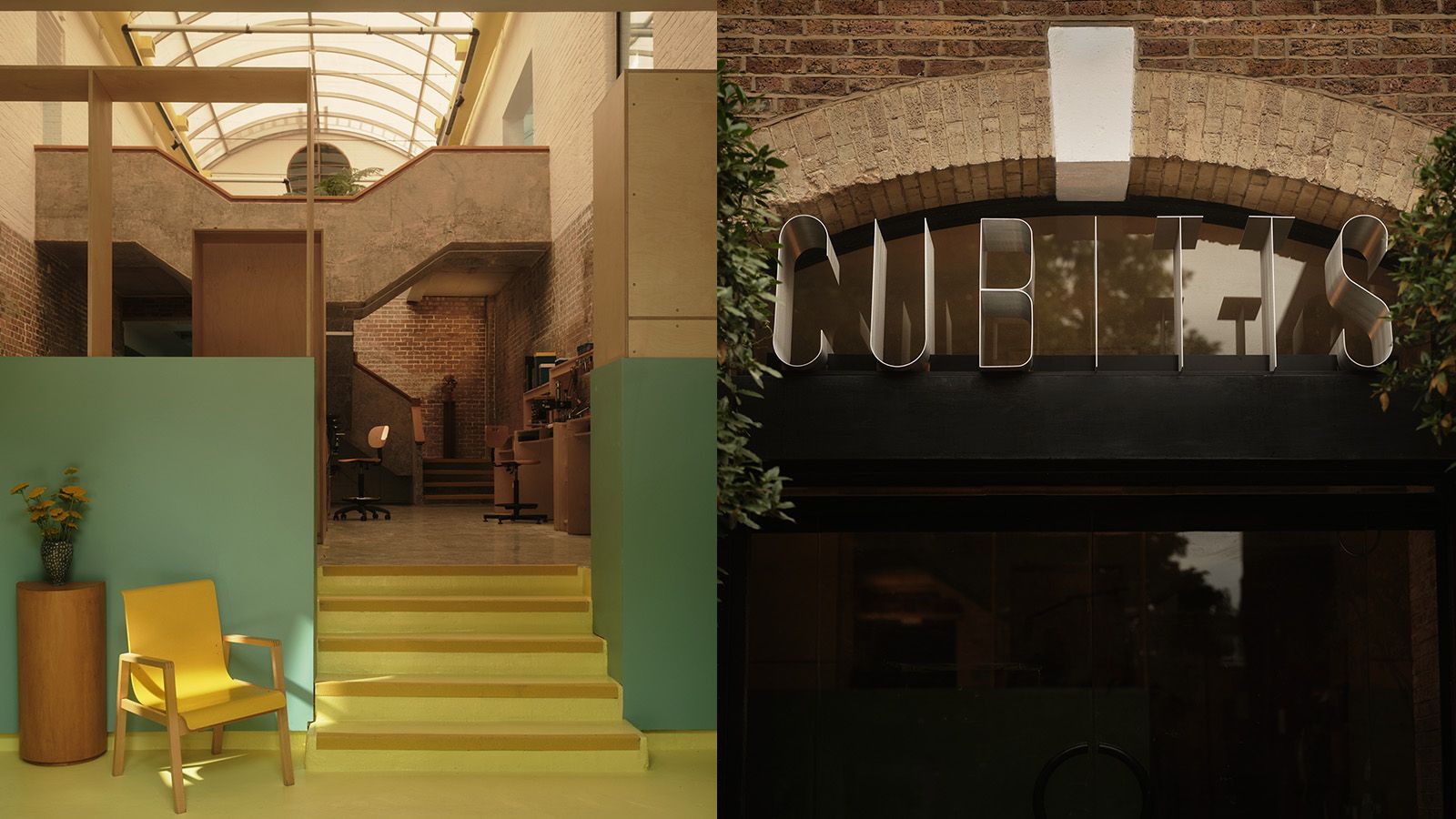
As trends in workspace and retail keep shifting, Cubitts, the British spectacle maker, unveils today (25 June 2026) its new headquarters – a home for the brand's entire operation. Set near King's Cross, on the edge of north London, the new HQ is titled The Yard, and brings together frame making, lens production, design, repair, consultation, exhibition and training under one roof, in a subtly spectacular space that blends from design, production and client-facing services and events.
When he came across their current base, Cubitts' founder, Tom Broughton, had been mulling over the idea of a permanent home for his business for a while. The makers' previous studio and office were located in the area (Cubitts was founded in Kings Cross in 2013), but had far outgrown the available space – and given the brand's attention to detail and design-led aesthetic, it made absolute sense for them to have a bespoke home.
'We were constrained by the [old] space rather than enabled,’ says Broughton. ‘And here, I'm hopeful we will be enabled by [the new one]. We want it to be a space where you can be really proud to bring passers-by, neighbours, customers... It can be a place where people can spend time with each other.'
The new building occupies a former Victorian stables that once served the nearby Crosse & Blackwell vinegar brewery – the biggest in the capital. It had gone through different lives and uses since then and, when Cubitts came into the picture, it was in need of a refresh.
Keeping the original architecture's utilitarian, brick materiality, and warehouse-like character felt intuitive. It also aligned well with the sense of honesty, efficiency and calculated rawness that can also be detected in the spectacle brand's product.
Now, the project, on which Cubitts worked closely with studio 51 Architecture, is a mix of exposed period surfaces, refreshed historic details, pops of colour pops, and carefully selected, tactile furniture – which makes the whole at once full of personality, comfortable and of its time.
Beyond style, however, Broughton's vision is indeed one of community, as he sees the new company's home as more than just a production facility or a set of desks. 'When we took on this [project], it was always like, how do we design it so it doesn't feel like an office? Which was why the office bit is a footprint of probably about 15 per cent of the building... The rest of it can be everything else that we want the [brand] to represent. Put the product at the middle. Have production under one roof.'
Receive our daily digest of inspiration, escapism and design stories from around the world direct to your inbox.
Enabling human potential through spaces that people want to inhabit in a meaningful way, fostering relationships and collaboration, was also a key driver: 'Our biggest cost by far is people. If you can create an environment where those people can flourish and work more effectively, it will pay for itself 100 times over. I don't think this is indulgent. I think it's necessary.'
In that spirit, everything is arranged around a central, double-height space – a kind of indoor 'plaza' – where a frame-making workshop operates: the business's heart. Also on the ground floor, around this area, are the company's production facilities and optical laboratory, which mix handmade elements and cutting-edge five-axis CNC machines.
A sequence of smaller, more cocooning areas offers space for private consultations, meetings and also room for the large Cubitts archive. Deskspace is upstairs, alongside a generous central kitchen and entertaining area – a fluid space Broughton hopes to use for the Cubitts community, from clients to creatives and locals. More rooms on the top level might develop into apartments for guests and creative residencies.
Beyond the architects, Cubitts collaborated with more creatives from its broad universe, who were involved in different parts of the building, helping to craft a home that feels a collaborative effort – but also a true representation of the brand's ethos as a whole.
'[The paint specialist] chose the [yellow] colour [throughout the interior] to match the yellow from a dress worn by Brigitte Bardot from the late 1960s,' Broughton explains, elaborating on his discussions with paint maker Simon March. Meanwhile, artist David Shrigley created a large mural – a brightly coloured cockerel – on the building's side, marking its creative nature and public-facing intentions.
The mural, the open-door policy and the series of events Cubitts is planning for the next few months all indicate the brand's vision to not only set strong roots in its new home but also be an active part of the neighbourhood.
'There's a little bench built into the front. And we found out from the neighbours that locally, it has been called “the seat of wisdom”. And people just stop there and have a think,' Broughton says. It's an element, and a spirit, he intends not only to maintain, but to build on – fostering creativity and community, hand by hand, in Cubitts' new London home.
Ellie Stathaki is the Architecture & Environment Director at Wallpaper*. She trained as an architect at the Aristotle University of Thessaloniki in Greece and studied architectural history at the Bartlett in London. Now an established journalist, she has been a member of the Wallpaper* team since 2006, visiting buildings across the globe and interviewing leading architects such as Tadao Ando and Rem Koolhaas. Ellie has also taken part in judging panels, moderated events, curated shows and contributed in books, such as The Contemporary House (Thames & Hudson, 2018), Glenn Sestig Architecture Diary (2020) and House London (2022).
This article was originally published by Wallpaper*.