This New and Improved Residency Program in Maine Is the Art World’s Best-Kept Secret
By By Eileen Kinsella
Seven years ago, the painter Reggie Burrows Hodges was living in Lewiston, Maine, and commuting to a 12-month residency at the Ellis-Beauregard Foundation in Rockland, an hour and a half drive away. He would often participate in Rockland’s First Fridays, a local event where galleries and museums open their doors to the public; Burrows Hodges sold work out of his studio at Ellis-Beauregard, asking about $50 for each painting.
It was on one of those First Fridays that his work caught the eye of local dealer Jake Dowling, of Dowling Walsh Gallery, who promptly gave him a solo exhibition. That showing tipped off Brendan Dugan, the founder of New York’s Karma, who organized summer pop-ups in Rockland for a number of years and began representing the Los Angeles-born painter shortly after.
Karma’s platform helped Burrows Hodges’s work quickly enter the collections of institutions as prestigious as the Met, LACMA, and Crystal Bridges and the artist become something of a cult figure in the art world—and a sought-after one at that. (The current auction record for his work is $882,000, set in 2024.) If the coastal residency that put him on the map has been a well-kept secret until now, that is about to change drastically, and fast.
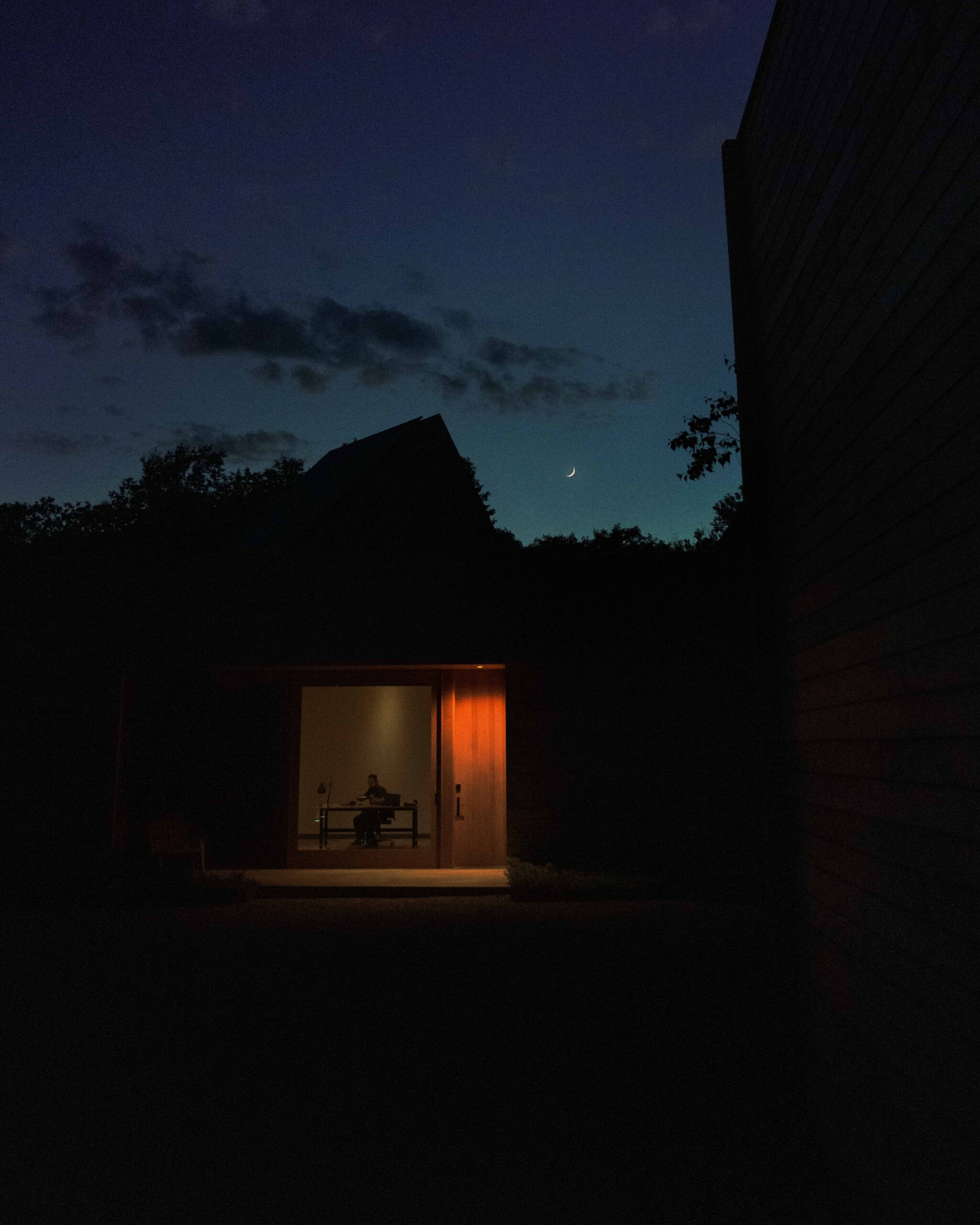
The Ellis-Beauregard Foundation is set to officially reveal two custom-built structures on its Rockland campus with a celebration on June 27. The new buildings will accommodate the Foundation’s growing residency, which up to now was housed in a transformed school building and not overnight-friendly. Now, a long, straight structure will provide living as well as working space for four artists, while an L-shaped building will serve as a flexible performance and exhibition space. “We really wanted a place where artists feel honored and safe, like they’re valued and not value-added,” founding executive director Donna McNeil told CULTURED earlier this month.
The Foundation chose the New York and Mount Desert Island-based Baird Architects, whose clients include MoMA PS1, the Kitchen, and the New York Studio School for the expansion. “We like to keep our money in Maine,” McNeil said, adding that when the call went out in 2021, it was “to AIA [American Institute of Architects] Maine only. We got probably every architect in the state—who doesn’t want an art space?”
Matthew Baird, the firm’s principal, considered himself an “outlier” at the start of the process, noting that “the Maine architectural scene is pretty tight.” He and his family came to the state right before the pandemic; he draws a parallel with the Foundation’s founders, the artists David Ellis and Joan Beauregard, who in the late ’70s traded their LES loft studios for a slower-paced life in Maine. (The Rockland home they built now houses the Foundation’s offices and archives.)
When the executive director job opened in 2015, McNeil had already retired from a storied career that included roles as a curator, overseeing a contemporary dance company, and running the Maine Arts Commission. “I threw my hat in the ring. They went for experience, and I got the programming up and running pretty quickly,” she said.
Since then, Ellis-Beauregard has hosted writers, filmmakers, photographers, even circus artists for anywhere from a month to a year. (Residents can reapply as well.) Artists in residency receive a stipend of $2,000 a month, and the foundation also allots five $10,000 grants to Maine artists, and three $50,000 cash awards for visual arts, choreography, and documentary film respectively annually. For context, the legendary Skowhegan residency in Madison, Maine, asks for a base tuition of $6,000 (which includes housing, food, and studio access); however, they do provide “significant scholarship funding” for accepted artists who can’t afford it. MacDowell, the oldest artist “colony” in the U.S., offers free admission for its 32 artist studios. (It comes as no surprise that in a moment of cost of living increases, inflation, and dwindling governmental support, the competition for private residencies has intensified. Gordon Knox of ResArtis, a network for artist residencies, shared that major programs now accept 10 percent of applicants at most.)
“Each residency is a mirror,” J. Bouey, a Brooklyn-based dancer and choreographer and an inaugural resident of Ellis-Beauregard’s new building this month, told me. “No two residencies are alike in their attempt to try to serve the same purpose, though they may overlap.” “I loved my time there,” shared artist Anne Buckwalter, celebrated for her quiet, highly detailed paintings of interior scenes. She participated in a month-long residency in 2023, after moving back to Maine, where she received her MFA from the Maine College of Art. “It’s very enchanting to be in a small coastal community where it feels like everyone knows each other. And Donna is an amazing connector of people.”
Baird also praised McNeil’s hospitality. “It was one of those projects that just seemed to flow. We’d meet at 4 p.m.; Donna would promptly adjourn the meeting at 5:30 because we would go over to her house for dinner with all the trustees and all of the artists. We got completely enmeshed into the culture of this place,” he shared. That intermingling has been at the core of artist residencies’ missions since MacDowell opened its doors in 1907; what Ellis-Beauregard has perfected is doing it with no strings attached. Unlike other programs, “there is no demand for a final project or product,” insisted McNeil. The residency “is just whatever the artists want it to be,” she added. “We’re a very small foundation, but we think big.”
More of our favorite stories from CULTURED
Sienna Spiro, Your New Favorite British Belter, Loves It When a Musician Puts Her in Her Place
‘House of Criticism’ Is for Fans, Not Critics: Johanna Fateman on the Jerry Saltz and Roberta Smith Doc
The Stars of Art Basel: Four Artists Having a Moment on the Fair Floor
15 Must-See Gallery Shows on View in London This Summer
How Chef Julia Turshen Cooked Up the Season’s Spiciest Queer Romance Novel
Sign up for our newsletter here to get these stories direct to your inbox.
Sign up for a digital subscription, starting at less than $3 a week.
Sign up for a digital subscription, starting at less than $2 a week.
You’re approaching your limit of complimentary articles. For expanded access, become a digital subscriber for less than $3 a week.
For less than the price of a cocktail, you can help independent journalism thrive.
For less than the price of a cocktail, you can help independent journalism thrive.
You’re approaching your limit of complimentary articles. For expanded access, become a digital subscriber for less than $3 a week.
For less than the price of a cocktail, you can help independent journalism thrive.
Support independent criticism for $10/month (or just $110/year).
This article was originally published by Cultured Magazine.