What Drew Simon Pegg, Charlotte Gainsbourg, and Quentin Tarantino to the Same Microbudget Dramedy?
By By Delaney Kim
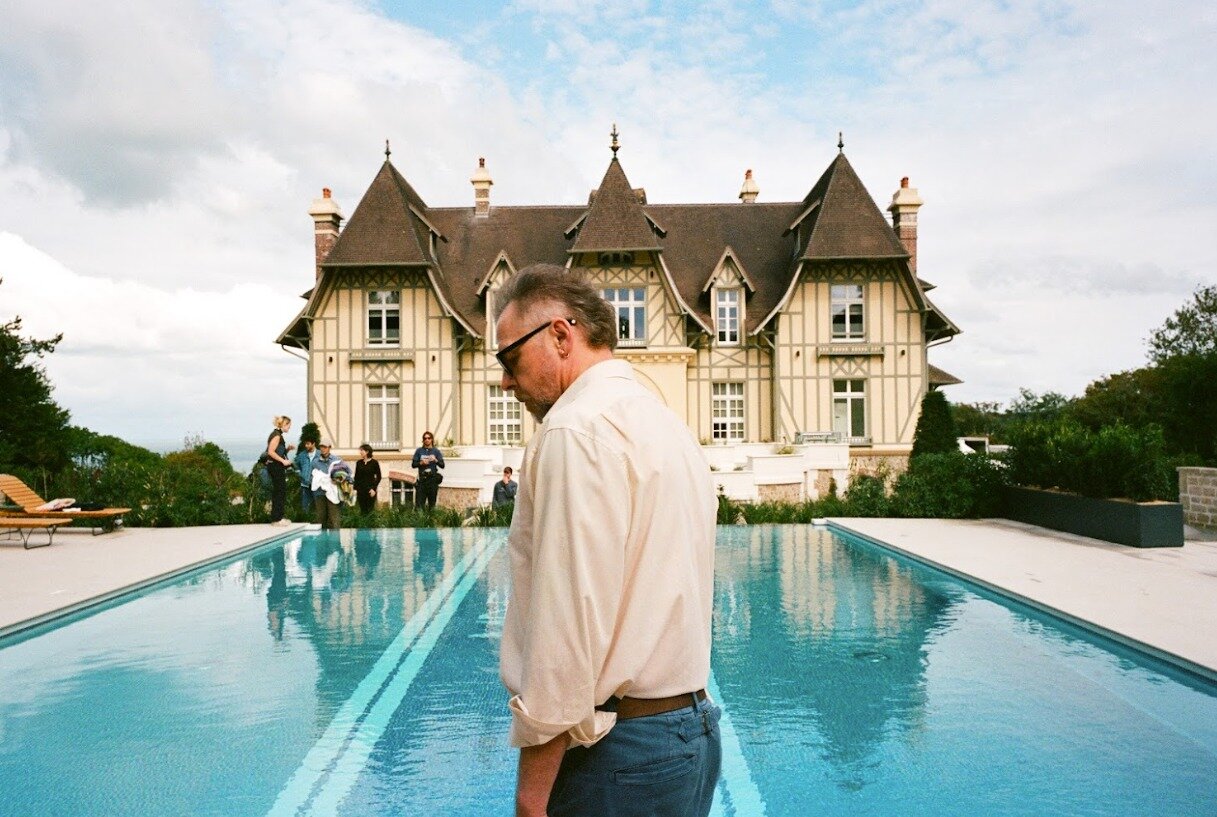
What draws actors like Simon Pegg and Charlotte Gainsbourg—whose careers span blockbuster franchises, arthouse classics, and decades in the spotlight—to a tiny independent film shot in just six days? The answer lies in Only What We Carry, director Jamie Adams’s new seaside dramedy set in Normandy. The film follows Charlotte, a dancer (played by Sofia Boutella) reconnecting with figures from her past, unearthing old secrets, and rediscovering the possibility of romance. Made on a modest budget—“There was no money to erase the pimple on my chin!” Gainsbourg jokes—and built around improvisation, Only What We Carry chooses quiet conversations over Hollywood provocation.
That sense of human intimacy is precisely what appealed to Pegg and Gainsbourg. Pegg stars as Julian, a former choreographer at the Moulin Rouge, while Gainsbourg plays Josephine, the sister of Charlotte, alongside an unlikely but high-wattage cast including Quentin Tarantino, Lizzie McAlpine, and Kylie Minogue. Both lead actors embraced Adams’s loose, spontaneous approach: there was no traditional script, and scenes were forged in the moment. For Pegg especially, the film’s fast timeline was invigorating. “I’d just come off two movies that had taken five years collectively to make,” he says, leaving the week-long shoot feeling less like a limitation than a liberation.
Here, Pegg and Gainsbourg discuss the appeal of slow, character-driven storytelling in an age of instant gratification and how balancing work with family and relationships has shaped them.
Did you know each other before this project? What were your initial perceptions, and how did you get involved?
Simon Pegg: I knew Charlotte before we worked together because I’m a big fan—I like her music. So I was delighted when Jamie said she was going to be involved. But when I met Charlotte, she said, “Who are you?”
Charlotte Gainsbourg: No, I didn’t! I knew Simon, but I’m ashamed because I’d only just seen Shaun of the Dead. Tim Roth told me, “You have to see this film. It’s a cult classic.” So I watched it very recently.
Pegg: That’s absolutely fine. It’s funny how that film continues to be discovered. I meet people who tell me, “I watched this when I was a kid,” which makes me feel old. The best thing you can hope for is that your films live on and are discovered by new people.
Gainsbourg: He reached out, though initially it was for another role. I was a bit slow to respond, and then he said, “Actually, it’s for this part.” It all seemed fun—the idea of making a film in six days and not being nervous because there was nothing I could prepare.
Pegg: The first thing he said to me was, “You’re sitting on the sofa of your childhood home. Tell me about it.” We went right back to Julian’s childhood, his relationship with his parents, and his upbringing. I got the offer and it basically said, “We’re making a movie in six days, and you’re going to make it up as you go along.”
I’d just come off two movies that had taken five years collectively to make, back to back. I was so over it. I thought, I want to do this. This is the absolute antithesis of that.
Gainsbourg: How did you hear about Jamie? Did you know him before?
Pegg: A package came through with his proposal, the story outline, and a list of his previous films. I watched Wild Honey Pie and Black Mountain Poets to get a sense of what he was about. At first I thought, This isn’t going to work. How can you make a feature film in six days? It just didn’t compute. But I loved his approach.
Gainsbourg: It felt like a breath of fresh air compared to other experiences. Actually, it became a little frustrating in the end because you want more of everything. The scenes were fun, and I was having too much fun for it to be over in six days.
Pegg: I know what you mean. It felt a bit like going back to school. It reminded me why I love my job so much. Big movies can start to feel like work because you’re a tiny cog in a huge machine. Not to decry my experience on Mission: Impossible—it’s great fun—but this felt different.
Gainsbourg: Me too. I had a similar experience on The Science of Sleep. It wasn’t made in six days—it was maybe 20—but it had that same lighthearted spirit: put the camera anywhere and let’s just mess around together. It was a very unpretentious way of making films.
Pegg: And it was such a small crew. It felt like a little group of us doing the same thing. I loved hanging out in the evenings, talking about the day while Lizzie played guitar. It felt like summer camp. It was too short.
Gainsbourg: Were you surprised by the film when you saw it?
Pegg: Yeah, I think I was surprised because we shot around 24 hours of footage—we filmed about four hours a day—and Jamie always says that when he gets the footage, that’s when he finds the script. He edits it down. Seeing it condensed into such a cohesive narrative, with all the ideas and emotions we were trying to convey still there, was a pleasant surprise. It made me proud of what we’d done because it really works.
Gainsbourg: I had such fun because it was so improvised and unpredictable. It all happened in a funny way.
Pegg: The response at the premiere has been really positive. People came out moved—there were a lot of tears. Lizzie’s song is so beautiful, and it works perfectly over the closing credits. She even performed it live after the screening, which was lovely.
How much say did you have in your wardrobe?
Gainsbourg: It happened very easily. I already had a lot of clothes with me, and the costume designer really liked the more masculine suits and tailoring. The only thing was that, with these low-budget films, I had this huge pimple, and obviously it didn’t disappear in six days. There was no money to erase the pimple on my chin! So I was very focused on that.
Pegg: There was a scene where I wore short sleeves, and I have tattoos that I usually cover up because they’re mine—they don’t belong to the character. They’re very personal. But we didn’t have time to cover them up, so I had to let them become part of Julian, which was an interesting experience.
Gainsbourg: Have you ever shown them in another film?
Pegg: No, never. I had to make a little mental adjustment and think, Okay, these are just his now, and imagine a different story behind each one.
Gainsbourg: That’s funny. I always keep very personal things with me. I wore my own watch in the film. I also used to wear a bracelet from my mother. It’s a very sentimental piece, and I love having it in films.
Pegg: That’s cool. A little anchor to yourself.
In the original treatment, did John and Josephine actually get together? There’s something wonderful about the fact that they don’t. I think it’s better that way. Do you?
Gainsbourg: I was frustrated. I wanted Josephine to go to New York and follow him. That’s my very sappy side. I’m sure it’s better to leave a little frustration.
Pegg: She’s made certain decisions in her life that she has to abide by. But that doesn’t stop you from being human and having other feelings.
Gainsbourg: Yeah. I guess she goes back to her very normal life. So, what are you up to now?
Pegg: There’s a couple of screenings, and then I’m heading home. I actually did another movie with Jamie in February. My daughter is in it—she played my niece. She’s very keen to act, probably because she’s grown up around it. Was that how it felt for you? You went into both of your parents’ professions [Charlotte is the daughter of Serge Gainsbourg and Jane Birkin].
Gainsbourg: Yeah, I started when I was 12. Everything happened at once, and the good thing was that I didn’t have time to think about who my parents were or whether I had any talent. Those questions came later, when I was already established. It didn’t make things easier but I’d already started, so it wasn’t a question of whether I would do it or not.
But it took me years to accept that I wanted to be an actress. When I was 19, my agent told me, “You have to stop saying you’re only available during holidays. You have to decide if you want to be an actress.” I really wanted to go to art school, and I had to let that go because I thought, Maybe he’s right. So I finally said, “I want to be an actress.”
Pegg: She’s 16—almost 17—and looking at universities. She wants to study acting. There’s this whole thing about nepo babies, which I think is silly because nobody says it about dentists or doctors.
Gainsbourg: Exactly. If you love your job, it’s natural for your children to feel that, even if you never push them. I was disappointed that none of my three children were interested in the arts. My son is now, but it took him a long time. I understand why. It’s difficult being the child of someone famous because you know you’ll be criticized for it.
Pegg: Ultimately, no amount of connection to the business helps if you can’t actually do the job. I went to see my daughter’s school production of Les Misérables. She played Monsieur Thénardier, the Master of the House, and I sat there thinking, Oh, she’s going to do this for a living. I hadn’t even suggested her to Jamie. Initially, there was just a FaceTime scene with my daughter, and I said, “Let’s get Tilly to do that.” Then Jamie said, “Why doesn’t she play this role in the film?” So it wasn’t me pushing her on him—he spearheaded the idea. I agreed because I thought, She can do this. And she blew everyone away.
Gainsbourg: Oh wow. Did you like shooting with your daughter?
Pegg: I did. I was incredibly proud. I was nervous at first because I didn’t know how she’d react. She wasn’t needed for the first few days, but she still came to set because she was off school. On the drive home we’d improvise scenes together and pretend to be uncle and niece. She was so eager to get started. I’m very protective, so I was on edge when we shot our first scene. But she knocked it out of the park.
Gainsbourg: The only experience I’ve had acting with our son was in one of Yvan [Attal]’s films—my husband is a director. I found it difficult because he was directing us, so we were under orders in a way. It was hard to watch him work with our son because we weren’t all on the same level.
I think Ben, our son, loved it though. Because Yvan was getting wonderful things out of him—you could see it. But I just don’t like seeing my son go through difficult emotions.
Pegg: I know exactly what you mean. The first scene I did with Tilly, she had to cry. She comes to talk to me about her father, who’s wayward and has disappointed her. Her little chin started to wobble and her lips swelled up. And I was in this strange position where part of me was thinking, Wow, you’re doing really well, and another part was thinking, My daughter’s crying. I just wanted to give her a hug.
You had incredibly famous parents. I didn’t have anyone in the industry to safeguard me or warn me about the pitfalls. So it’s nice to be in that position now.
Gainsbourg: That’s true. But my parents were terrified that success would go to my head. I was very modest but that didn’t help either. I understand why people dislike child actors, but at the same time, a little more self-esteem wouldn’t have hurt.
Pegg: That’s important because you need armor in this business. You have to know yourself so that when the setbacks come—and they do—you can weather them and not be completely crushed. What role did you play when you were 12?
Gainsbourg: It was a small role in a film called Paroles et Musique—Lyrics and Music. I acted with Catherine Deneuve, who knew my parents, so my mother was reassured that I’d be in good hands. It wasn’t a great film, but I have wonderful memories of it. I realized only today that I was just 12. I was about to turn 13 when I went to Montreal to shoot the final scenes, and they let me travel on my own. I had my own hotel room. It was this incredible adventure. Then I went straight into another film where I had the lead role, so I had a lot to do. Again, I spent the whole summer alone with the film crew. It was really extraordinary.
Pegg: Were you aware of Catherine’s status? Did you think, I’m in a film with movie stars?
Gainsbourg: Not really. I knew people were famous, but I don’t think it mattered much to me.
Pegg: I think you have a responsibility when you’re working with young people.
Gainsbourg: Little ones, yes. I find it very emotional and endearing to watch young people start out—to see their appetite, their shyness. I don’t know whether that’s something you wanted to see in your daughter, but I find it charming.
Pegg: It’s innocence, but also a lack of cynicism and agenda. They’re just there to play. And that’s essentially what we do for a living—we pretend. I suppose they’re closer to that stage in life when pretending was all they did. There’s an honesty and authenticity there, as long as they’re not acting. I think that’s the difference. The best child performances are often when the child genuinely believes they’re in the situation.
Oh, and I also meant to tell you something. I made a film earlier this year, in Antigua and Montreal, with a French-Canadian director named Alexandre [Carrière]. He loved playing music on set, especially for emotional scenes. So I spent the first few months of the year listening to you sing “Blurry Moon.”
Gainsbourg: How funny. That song just happened. It was written quickly, originally for a fashion show. Then it became this whole thing, with the music video Anthony [Vaccarello, Yves Saint Laurent’s creative director] wanted to make. It’s nice to have projects that happen innocently.
Pegg: They don’t require endless head-scratching. They simply come into being—which is exactly what our film was.
I was talking to Sofia earlier today. I was frustrated because Julian is actually very sweet with her. He’s happy to see her but she was trying to find the abuser in him: This is the man who made my life miserable. That’s what led her to write that letter, so she could confront Julian and make him read aloud all the things he’d done. That was never in Jamie’s treatment. It was just something Sofia felt her character needed to do. And it became a pivotal moment in the film, because suddenly Julian has to list his transgressions and admit that he can’t simply pretend none of it happened.
Pegg: That’s one of the amazing things about having the freedom to explore characters and their motivations. Jamie kept everyone’s agenda hidden. That meant we all had our own ideas about where the story should go. Like you said earlier—you wanted Josephine to go to New York. You had to follow your character’s desires rather than the larger story. Spoiler alert, but when Julian asks Sofia’s character to stay in Dublin, I wanted that to be the end of the film. That was fascinating to me. And honestly, it made me want to make more films like this.
Gainsbourg: I wish I could do more. I don’t think I’m an actress who likes to construct a role piece by piece. I feel like this way of working is absolutely
This article was originally published by Cultured Magazine.