Alan Saret, Post-Minimal Sculptor of Spiritual Forms, Dies at 81
By Vittoria Benzine
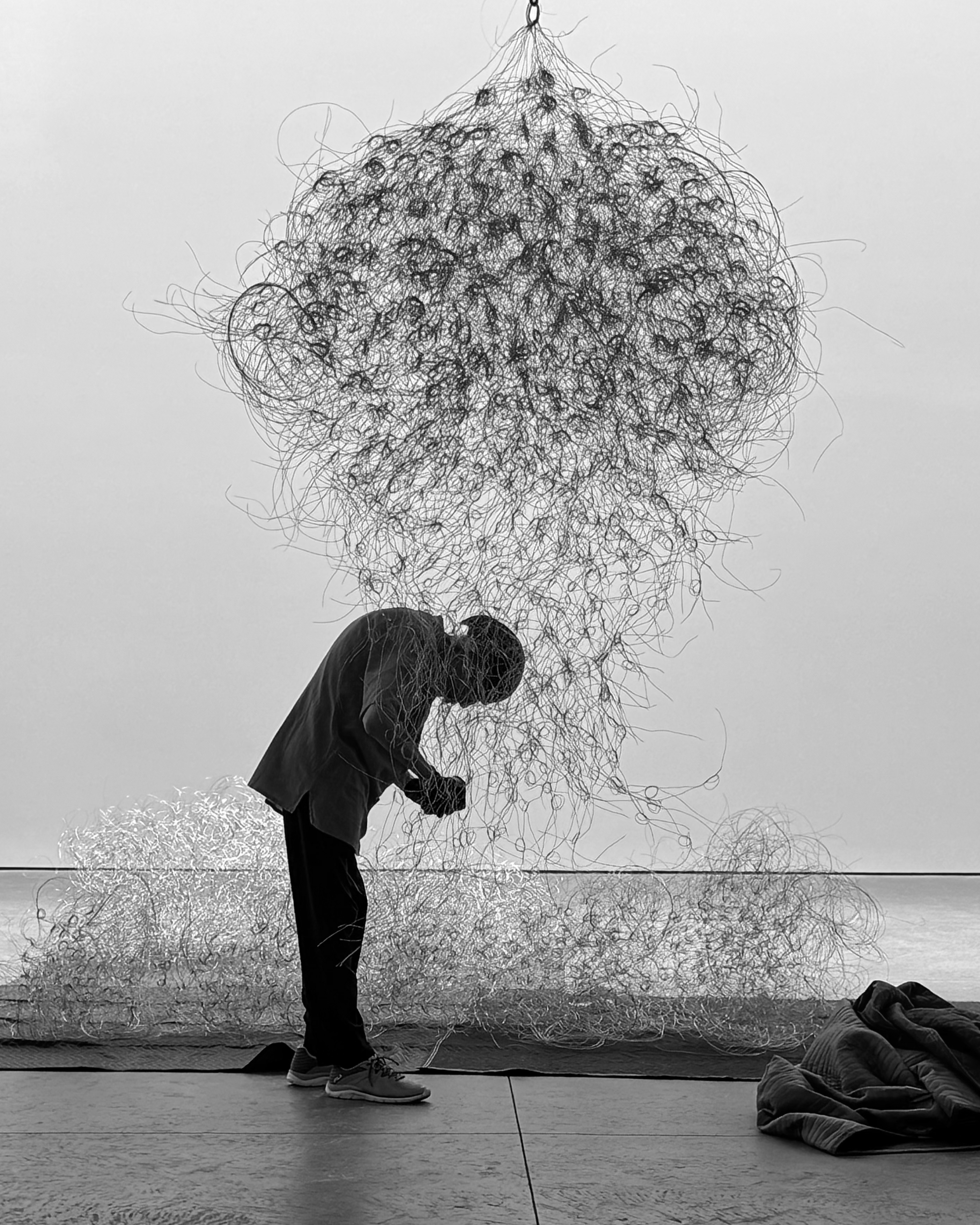
Alan Saret, the spiritually ambitious sculptor associated with SoHo’s Post-Minimalist art scene, has died at the age of 81.
Sign up for our daily newsletter.
The artist “defied historical categories to pursue what he termed ‘ensoulment,’ art informed in equal parts by spirituality, mathematics, nature, and the built environment,” Karma, Saret’s New York gallery, said in a statement.
Sign up for our daily newsletter.
Not much is publicly known of Saret’s upbringing, aside from the fact that he was born on Christmas Day 1944 in New York City. From there, the record generally resumes in 1961, when he began studying architecture at Cornell University. There, Saret studied under architect and artist Paolo Soleri, a utopian city planner. A year after he graduated in 1966, Saret enrolled at Hunter College in New York, studying art under Robert Morris—an early and critical proponent of Minimalism.
Alan Saret, “Galacticonexus” exhibition installation view at Karma, New York, July 24 through September 13, 2025. Photo: courtesy of Karma.
There, Saret started making his signature wire sculptures. “Putting current labels of ‘anti-form’ aside,” critic Emily Wasserman wrote of his debut solo show the same year he finished at Hunter, “23-year-old Saret has, to my knowledge, been working for over a year with chicken wire, soft rubber, electrical and fencing wire, and other flimsy materials, creating strangely reticent, though airy, energetic and lyrical webs, clusters, and billows.” Wasserman considered them too airy to be called sculptures.
That exhibition took place at SoHo’s short-lived but high-impact Bykert Gallery, which also offered breakthrough debut outings to eventual legends like Lynda Benglis and Brice Marden. (Saret was among the artists who helped found 112 Greene Street, the consequential alternative art space that became White Columns.)
Alan Saret, “Gang Drawings” exhibition installation view at The Drawing Center, New York (2007) Photo: courtesy of Karma.
Saret worked briefly as an engineer at the Port Authority during the early days of his career. Graph paper he is said to have pilfered from the office offered surfaces for his first “Gang Drawings”—compositions created by gesturing with a whole cluster of colored pencils at once. Scores of such works produced between 1967 and 2003 sat at the center of the 2007 Drawing Center exhibition that reintroduced Saret to a new generation, decades after he’d slipped himself into obscurity. Those early “Gang Drawings” served as sketches for Saret’s ongoing explorations in meticulous wire sculptures that somehow still felt like they’d sprouted themselves, comprised of wide-ranging materials like rubber, mesh, cloth, sulfur, ribbons, and wood.
A crush of opportunity followed Saret’s first solo. In 1968, he appeared in Morris’s landmark Post-Minimal grpi[ exhibition at Leo Castelli Gallery, “9 in a Warehouse”—plus that year’s sculpture-focused Whitney Annual, alongside artists like Louise Bourgeois, Donald Judd, and Alexander Calder. In 1969, Saret won a Guggenheim fellowship and contributed to the controversial Kunsthalle Bern show “Live in Your Head: When Attitudes Become Form.” He also rejected an invitation to participate in the Whitney’s group show “Anti-Illusion: Procedures/Materials,” on the basis of its name. Instead, Saret showed work in his newly upgraded studio, a Tribeca loft. Artforum reviewed that presentation in its March 1970 issue, which featured Saret on the cover.
Alan Saret The Hole at P.S. 1, Fifth Solar Chthonic Wall Temple (1976) installation view at P.S. 1 Contemporary Art Center, New York Photo: courtesy of Karma.
Saret also featured in New Delhi’s 1971 India Triennale. He was so taken with the country that he stayed for several years “to pursue spiritual studies,” according to Karma. In 1973, Saret staged a solo show at the historic Clock Tower gallery (now home to Jack Shainman) in Manhattan’s Tribeca neighborhood. In 1975, he installed the monumental Ghosthouse (1975) at Lewiston, New York’s Artpark—and won a National Endowment for the Arts grant. One year later, he installed The Hole at P.S. 1, Fifth Solar Chthonic Wall Temple to help mark the opening of that storied titular art center, Now MoMA PS1. It’s still on view.
Alan Saret, Ghosthouse, Stage II (1975) installation view at Artpark, Lewiston, New York (1975) Photo: courtesy of Karma.
In 1980, Saret moved to Harrison, Arkansas, though he continued mounting exhibitions with galleries and institutions in New York, Santa Barbara, and Costa Mesa. By the end of the decade, he tried returning to New York City, where the art market boom was crescendoing. Although Saret continued appearing at the Whitney, the Museum of Contemporary Art Los Angeles, and several other spots in between, the 2007 Drawing Center show marked his first solo outing since his 1990 retrospective at P.S. 1. Saret joined Karma’s roster in 2021. The artist never married and did not have children.
“During his years away from the art world, Alan continued to work privately and developed several deeply personal bodies of work, including geometric drawings, language-based works, representational drawings and paintings, and music,” a Karma representative said in an email.
The gallery has held three solo shows dedicated to Saret since their partnership began, including a 2024 extravaganza where Saret’s entire, varied practice took over all three of the gallery’s East Village locations, with pieces dating as far back at 1974. “However, to this day, some bodies of work from this period have never been exhibited,” Karma said. In the meantime, Saret’s influence on contemporary art—from his organic techniques to his spiritual concepts—endures.
This article was originally published by Artnet News.
