The New Crystal Bridges Tells a More Honest Story About American Art
By By Ann Binlot
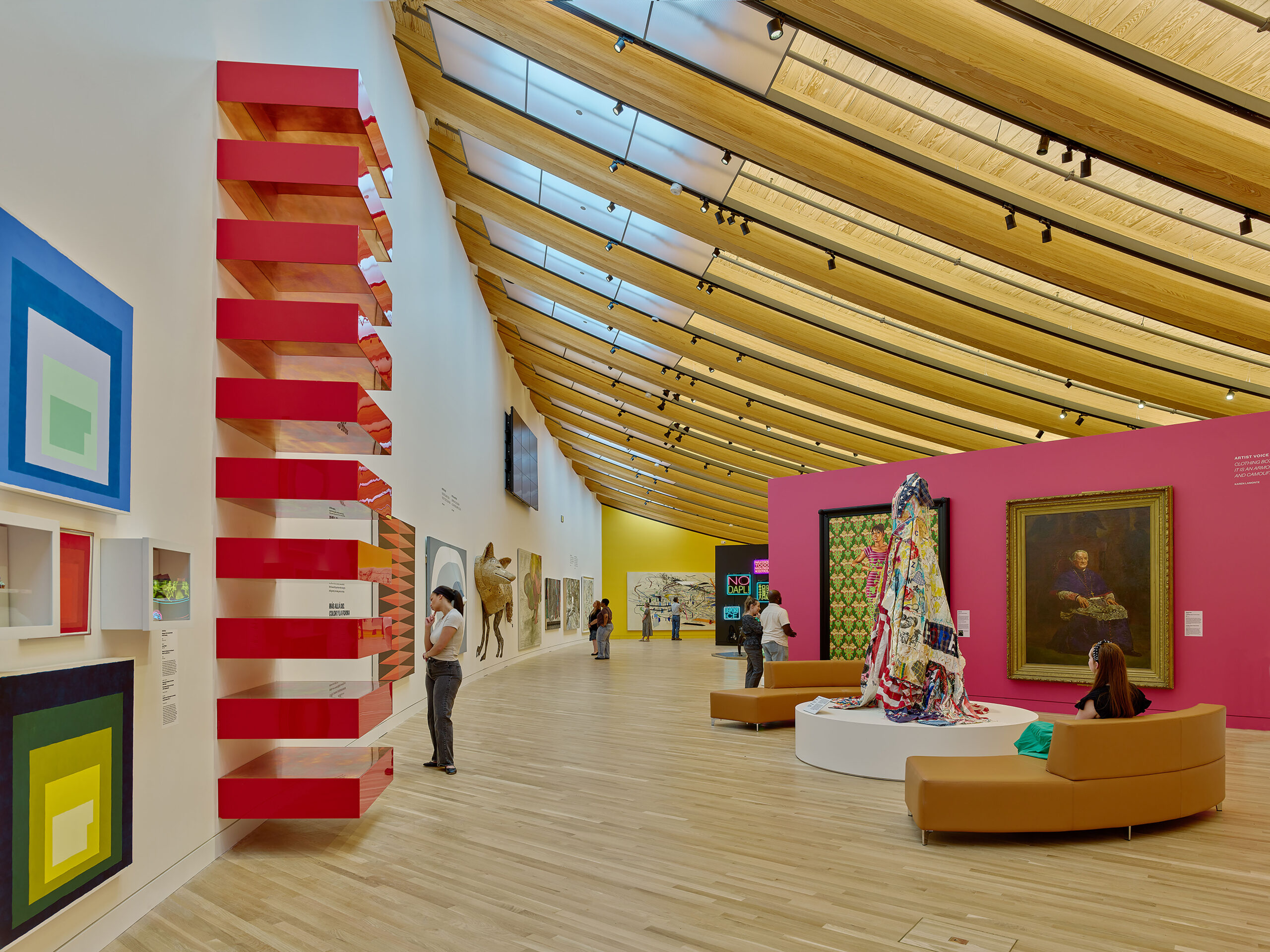
Walmart heiress Alice Walton opened the Crystal Bridges Museum of American Art in 2011 with the intention of making world class art more accessible to audiences in the South-Central United States. With its 114,000-square-foot Moshe Safdie-designed expansion, which opens June 6, she’s doubling down on that mission—literally. The addition expands the museum’s exhibition space by 50 percent. It has also compelled the institution to ask itself a big question. The 15 years between when Crystal Bridges first opened in Bentonville, Arkansas, and today exposed the fault lines in a country that has never been more fragmented. Against this backdrop, who gets to decide what American art is?
“The story of America is ultimately a story of many voices,” Olivia Walton, the board chair of Crystal Bridges (and a 2026 Cult100 honoree), tells CULTURED. “We have an opportunity—and I would argue a responsibility—to widen that lens and reflect a fuller picture of the country and the people who have shaped it.”
Welcoming visitors to the expansion is The Enforcer, a beaded sculpture by Native American artist Jeffrey Gibson originally exhibited at the American Pavilion of the 2024 Venice Biennale. Recalling Mississippian effigy pots, the work references the Enforcement Acts of 1870 and 1871, which were designed to protect Black Americans’ civil rights during the Reconstruction era. “Everyone who comes to Crystal Bridges will see The Enforcer, and that was intentional,” says Jordan Poorman Cocker, the museum’s curator of Indigenous art.
With recent studies finding that museum collections remain overwhelmingly white and male, the predominantly female Crystal Bridges curatorial team is working to tell a story about American art that is not only more diverse, but also more historically accurate. “Indigenous art and Indigenous people have been creating, producing, and living in the place now known as America for thousands of years,” Poorman Cocker, who was appointed in 2023, tells me as we sit in front of a tapestry woven by Native American artist Lola S. Cody.
The new David Booth Gallery, dedicated to contemporary American art, offers an instructively heterogenous picture of a history defined by migration: Cody’s weaving hangs near a suite of neons from 2021 by Filipino, Mexican, and Native American artist Patrick Martinez; a 2018 bronze-and-steel sculpture by Black American artist Hank Willis Thomas; a minimalist orange 1989 stack by American artist Donald Judd; a 1978 abstract work by Cuban artist Zilia Sánchez; and a 2018 Infinity Room by Japanese artist Yayoi Kusama. The expansion also seeks to cultivate a new generation of American artists with the Hub, a creative learning center and studio.
“My intention is to continue centering Indigenous art and artistic perspectives,” said Poorman Cocker, who is slated to organize an exhibition of Indigenous art titled “Native Beauty” that will open in October 2027. “Powerful shifts happen when curators and institutions center the voices of artists.”
More of our favorite stories from CULTURED
At 101, the Chinese American Artist Ce Roser Is Finally Getting Her Big Break
Yes, Kane Parsons Directed ‘Backrooms.’ Here’s How It All Went Down.
The Gayest Places in New York, According to Queer Culturati
Director Boots Riley and George Clinton Disagree About the Future of A.I.
The 8 Must-See Movies at Tribeca This June, According to the Ultimate Insider
Sign up for our newsletter here to get these stories direct to your inbox.
Sign up for a digital subscription, starting at less than $3 a week.
Sign up for a digital subscription, starting at less than $2 a week.
You’re approaching your limit of complimentary articles. For expanded access, become a digital subscriber for less than $3 a week.
For less than the price of a cocktail, you can help independent journalism thrive.
For less than the price of a cocktail, you can help independent journalism thrive.
You’re approaching your limit of complimentary articles. For expanded access, become a digital subscriber for less than $3 a week.
For less than the price of a cocktail, you can help independent journalism thrive.
Support independent criticism for $10/month (or just $110/year).
This article was originally published by Cultured Magazine.