At 101, the Chinese American Artist Ce Roser Is Finally Getting Her Big Break
By By Sarah Cascone
This is “The Overlook,” a column by Sarah Cascone about the lives and work of artists who have been passed over, excluded from, or otherwise left out of the mainstream art world. A veteran arts and culture writer, Cascone helped launch Artnet News in 2014 and has spent more than a decade reporting on the intersection of art, media, culture, and politics, with a focus on women artists. True to its name, “The Overlook” takes a broad view of the art ecosystem while uncovering stories that have not received the attention they deserve.
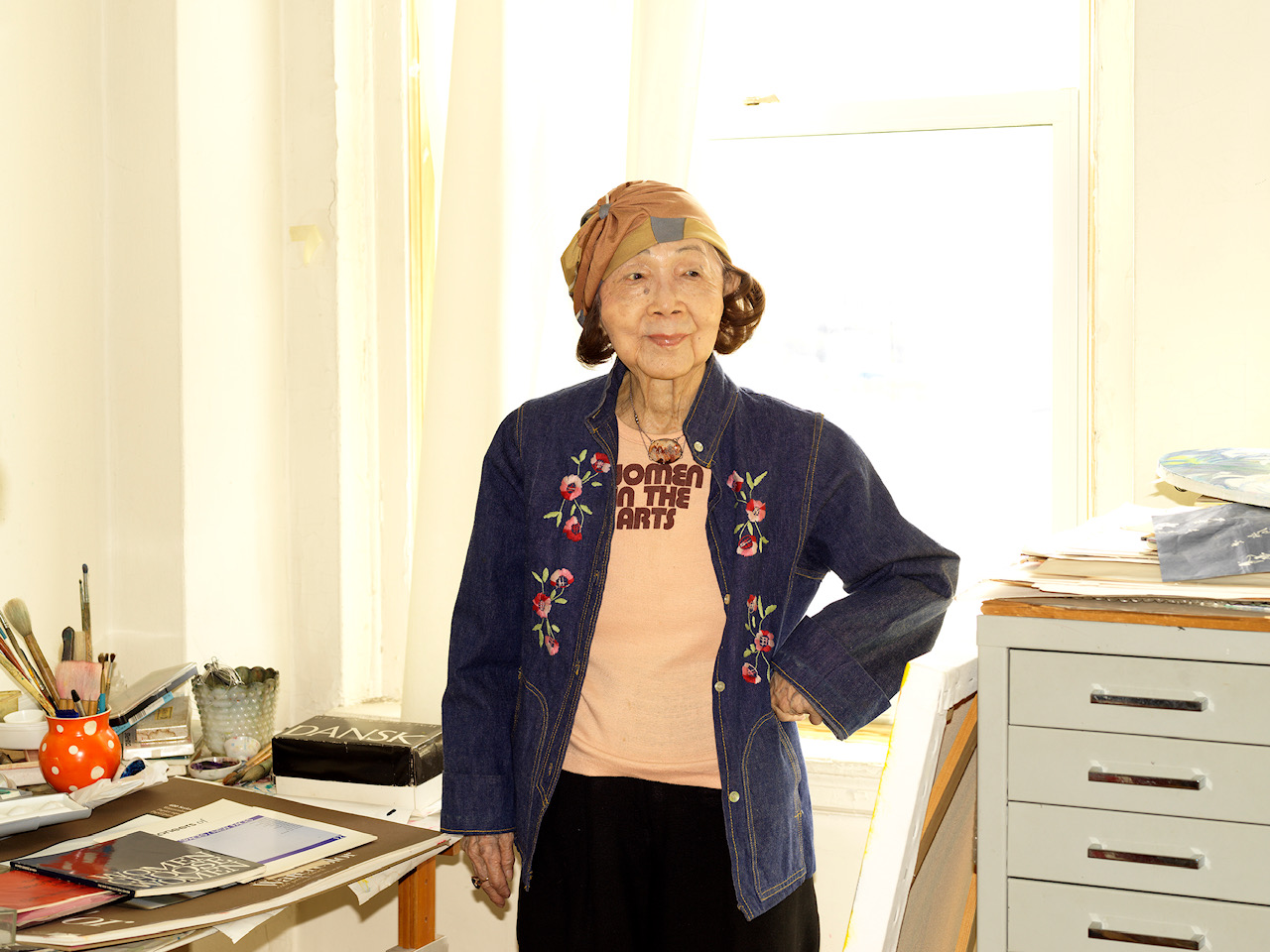
One of the advantages of being a woman artist, the Guerrilla Girls famously said, is “knowing your career might pick up after you’re 80.” At 101, Ce Roser is still waiting—but maybe not for much longer. Earlier this month, the New York artist’s first solo show in more than 30 years opened at Sebastian Gladstone in Tribeca.
“It’s the culmination of 100 years,” Roser said of the exhibition. “It was really a fulfillment of a dream I never had. I didn’t think it would happen.”
Born to Chinese American parents in Philadelphia in 1925, Roser was artistically inclined from childhood. But she started her career at the U.S. Embassy’s Information Service, her fluency in Chinese serving her well at the office’s wartime headquarters in Chongqing, China. There, she met Hal Roser, who she would marry at just 21. (He died in 1990.) Hal’s work for the American Foreign Service led the couple to stints in the Philippines, India, Pakistan, and Berlin—and forced Roser to leave government work, because she wasn’t allowed to work under her spouse.
Fortuitously, a friend lent Roser an oil paint set: “I took one of my photographs, and I did a painting. My husband took it to be framed, and somebody wanted to buy it. So I decided, as a foreign service wife, maybe this is what I could do,” she recalled.
We spoke over apple cider with her son, the artist and musician Lorin Roser, in her 11th-story Upper West Side apartment, which boasts sweeping views across the Hudson to the Palisades in New Jersey. Roser moved in when she was just 27, and the vista has deeply informed her work over the years—the clouds, the river, and the breeze inspiring her colorful, undulating abstractions.
“Because I’m so high up, you could be in the mountains. You see only trees,” Roser said, pointing out that the city streets are only visible if you look straight down. “For at least 40 years, Macy’s had its fireworks on the Hudson, right in front of me. And every year, I would give a party.”
The raw beauty and power of those explosive, radiating fireworks helped inspire much of Roser’s work currently on view at Sebastian Gladstone. The canvases feel light and airy, with a sense of movement underscored by repeated arching shapes that seem to extend beyond the edge of the painting from one work to another.
“All the things that are unresolved, when you paint, you resolve them. It’s very useful in keeping you sane,” Roser said. “Everything you see, everything you do, can go into a painting. So it’s a container of your thoughts, your dreams, your speculations, your disappointments.”
Sebastian Gladstone—an upstart who founded his gallery in Los Angeles in 2020 and expanded to New York last year—may seem like an unlikely champion for Roser. Yet he is part of a contingent of younger dealers who are cultivating the careers of artists and estates previously overlooked by the establishment. It was the widow of another artist represented by the gallery, the Abstract Expressionist painter Herman Cherry, who suggested Gladstone meet Roser. After carefully sorting through stacks of dusty canvases piled around her apartment, the dealer chose a group of works from between 1977 to 1986 for Roser’s reintroduction to the New York art world.
“There’s a delicacy and a confidence in her mark making from this period that I really appreciate,” Gladstone said, noting that most of the works had not left her apartment in decades. Roser likened letting go of them to “saying goodbye to your children.”
Now in her second century, Roser still paints—although preparing for the Sebastian Gladstone exhibition has taken up most of her energy recently. In the show’s opening weeks, the gallery sold eight of her lyrical abstractions. The prices, which range from $28,000 to $54,000, have been carefully calibrated to balance the market’s unfamiliarity with Roser and her long career as both a painter and an activist supporting women artists.
Having trained at the Berlin Art Academy while living in the German city in the early 1950s, she joined the American Abstract Artists group after returning to the States. The artist and critic Charmion Von Wiegand became a close friend, and introduced Roser to the dealer Ruth White, who gave Roser her first show in 1961.
Fighting for female representation at museums, Roser cofounded the Women in the Arts Foundation in 1971, a group that still exists today. The likes of Elaine de Kooning, Alice Neel, and Louise Bourgeois attended their protests, which led to major group exhibitions dedicated to women artists at the Brooklyn Museum and the Museum of Arts and Design (then the New York Cultural Center).
Roser’s career did not go completely unrecognized—she is in the collection of more than 30 institutions, including New York’s Metropolitan Museum of Art, Museum of Modern Art, and Whitney Museum of American Art. But the bulk of her output is still in her studio, perhaps 100 oil paintings, an equal number of watercolors, and 40 or 50 collages. Before Gladstone, it was difficult for Roser to contemplate her legacy, and what would become of this art after she was gone.
“You hear these terrible stories about paintings going into landfill,” Roser said. “I felt that was a hopeless way of thinking. I was preserving it because I did it, and I loved doing it, and I thought it was important.”
As a young mother, Roser made the choice to separate her art from the rest of her life. “When you’re painting, no housework, no cooking—art alone. But when your family’s here, you don’t do any of that; you wait,” she said. Hal and Lorin never saw her paint: “It’s my secret self.”
“When I finally got to the canvas,” Roser added, “I was so eager to work. All I had to do was go up to the canvas and [it] came floating out of me with absolutely no effort.”
“Ce Roser: Ten to Get Ready, and Ten to Go” is on view at Sebastian Gladstone, 36 White Street, New York, New York, May 1–June 13, 2026.
More of our favorite stories from CULTURED
The A.I. Revolution Has Come For Next-Gen Jobs. Jodi Kantor Sees a Way Forward.
72 Hours in Venice: Palazzos, Protests, and a Biennale on the Brink
Air de Paris, a Radical Stalwart of the French Gallery Scene, Is Closing
Who’s The Next Obsession? 12 European Collectors Reveal How They Discover New Talent
For His Next Act, Kareem Rahma Is Going Beyond Hot Takes
Sign up for our newsletter here to get these stories direct to your inbox.
Sign up for a digital subscription, starting at less than $3 a week.
Sign up for a digital subscription, starting at less than $2 a week.
You’re approaching your limit of complimentary articles. For expanded access, become a digital subscriber for less than $3 a week.
For less than the price of a cocktail, you can help independent journalism thrive.
For less than the price of a cocktail, you can help independent journalism thrive.
You’re approaching your limit of complimentary articles. For expanded access, become a digital subscriber for less than $3 a week.
For less than the price of a cocktail, you can help independent journalism thrive.
Support independent criticism for $10/month (or just $110/year).
This article was originally published by Cultured Magazine.
