
Juan Soriano De Lacandón
<p>In 1964 the artist Leonora Carrington painted this imaginative portrait of her friend, the self-taught artist Juan Soriano. A member of Surrealist circles in Paris and New York City during the 1930s and 1940s, Carrington settled in Mexico in 1942 after the trauma of fleeing war-torn Europe. Mexico occupied an important place in the imagination of many European artists—André Breton called it the “Surrealist place par excellence”—and for Carrington the country came to be a source of inspiration and wonder.</p> <p><em>Juan Soriano De Lacandón</em> was one of the first paintings in which Carrington combined her Surrealist-inspired dreamscapes with Mexico’s history, culture, and ancient practices. Inspired by her study of the indigenous Lacandón people for a 1963 mural commission, <em>The Magical World of the Maya</em> (Museo de Antropología e Historia, Mexico City), the artist portrayed Soriano surrounded by the flora and fauna of ancient Mayan mythology. Bearing the scarification marks of a shaman, he holds in his hand a small jaguar, admired by the Maya as a spiritually powerful creature and a conduit to the underworld. According to native belief, the shaman alone was privileged to assume the form of the jaguar. This notion of animal incarnation may have resonated with Carrington, who adopted the horse as a type of alter ego in her earlier work. In presenting Soriano as a revered holy man, the artist demonstrated her deep admiration for her subject. Her use of precolonial symbolism also suggests her assimilation into the world of her adopted homeland, where she remained until her death.<p>
Catalogue
- Year
- 1964
- Dimensions
- 40.3 × 80.3 cm (15 13/16 × 31 9/16 in.)
- Collection
- Art Institute of Chicago
- Artist
- Leonora Carrington
Artist

Painting
Mary Leonora Carrington was a British and Mexican Surrealist painter and novelist. She lived most of her adult life in Mexico City and was one of the last surviving participants in the Surrealist movement of the 1930s. Carrington was also a founding member of the women's liberation movement in Mexico during the 1970s.
Full artist profile →More
More by Leonora Carrington

And Then We Saw the Daughter of the Minotaur
1953 · Oil on canvas

Kitchen Clock (Pendule de la cuisine)
1943 · Watercolor, gouache, and pencil on colored paper

Green Tea
1942 · Oil on canvas
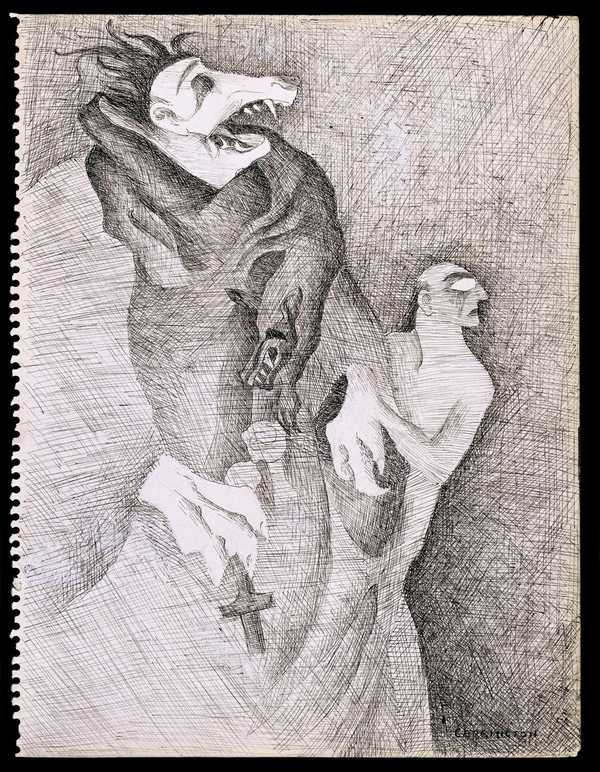
Do You Know My Aunt Eliza?
1941 · Ink on paper
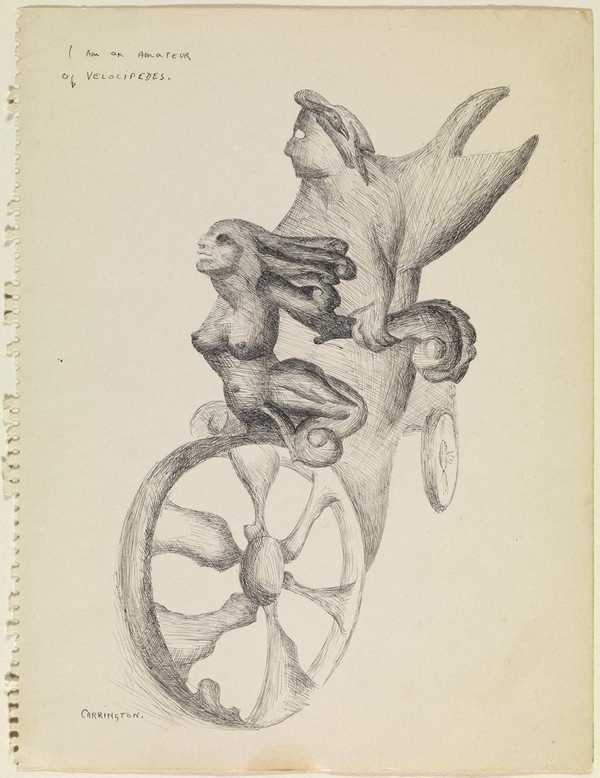
I am an Amateur of Velocipedes
1941 · Ink on paper

Design for the Tempest
1937 · Opaque watercolor with gold and silver metallic paint on ivory wove paper
Record
Verified by WattsOS- Artist
- Leonora Carrington
- Year
- 1964
- Dimensions
- 40.3 × 80.3 cm (15 13/16 × 31 9/16 in.)
- Watts ID
- WW-1964-028777
Source
- Collection
- Art Institute of Chicago
- Source
- aic
- Reference
- View at source
- Status
- verified