
The Awakening of the Forest
<p>Paul Delvaux painted <em>The Awakening of the Forest</em> in the late 1930s, after having adopted Surrealism as a visual language to give form to his inner world—one populated with childhood memories and fantasy. For this monumental painting, the artist transformed an episode from Jules Verne’s <em>Journey to the Center of the Earth</em> (1864), in which Professor Otto Lidenbrock and his nephew Axel discover a prehistoric forest deep inside the earth. Delvaux showed the professor at left, examining a rock or fossil; behind him stands Axel, who bears a striking resemblance to the artist himself. Under a full moon, a group of women in the background appear like automatons. In the foreground, several figures combine human and vegetal elements; these ambiguous figures seem to embody a primordial, as yet undifferentiated, state. A woman in the right foreground and another in the left middle ground, both in Victorian dress, hold lamps and try in a vain to shed light on the unyielding mystery of the scene. Despite the multitude of naked figures and their detailed description, <em>The Awakening of the Forest</em> retains a detachment that adds to its strange and mysterious effect.</p> <p>This is one of thirty-five works that comprise the Winterbotham Collection. <a href="https://www.artic.edu/the-winterbotham-collection">Click here to learn more about the collection.</a></p>
Catalogue
- Year
- 1939
- Medium
- Oil on canvas
- Dimensions
- 170.2 × 225.4 cm (67 × 88 3/4 in.)
- Collection
- Art Institute of Chicago
- Artist
- Paul Delvaux
Artist

Painting
Drawing on the formative experiences of his youth, Paul Delvaux’s shadowy, dream-like paintings convey a profound sense of curiosity and unease. In the Surrealist tradition of “poetic shock,” Delvaux’s art combines a bizarre set of recurring visual motifs to create eerie, disquieting scenes: nude women wander transfixed through darkened railway stations, grimacing skeletons peer from the shadows and puzzled scientists confer in long corridors. While he did not formally align himself with the Surrealists, Delvaux was distinctly indebted to artists like Giorgio de Chirico, René Magritte and Salvador Dalí, and the hallucinatory quality of his paintings was admired by the movement’s founder, André Breton.
Full artist profile →More
More by Paul Delvaux

The Sunday Dress
1967 · Lithograph

Champs Elysées
1966 · Pen and brush and black ink, with watercolor and pastel on ivory wove paper

The Lady with a Candle
1966 · Lithograph
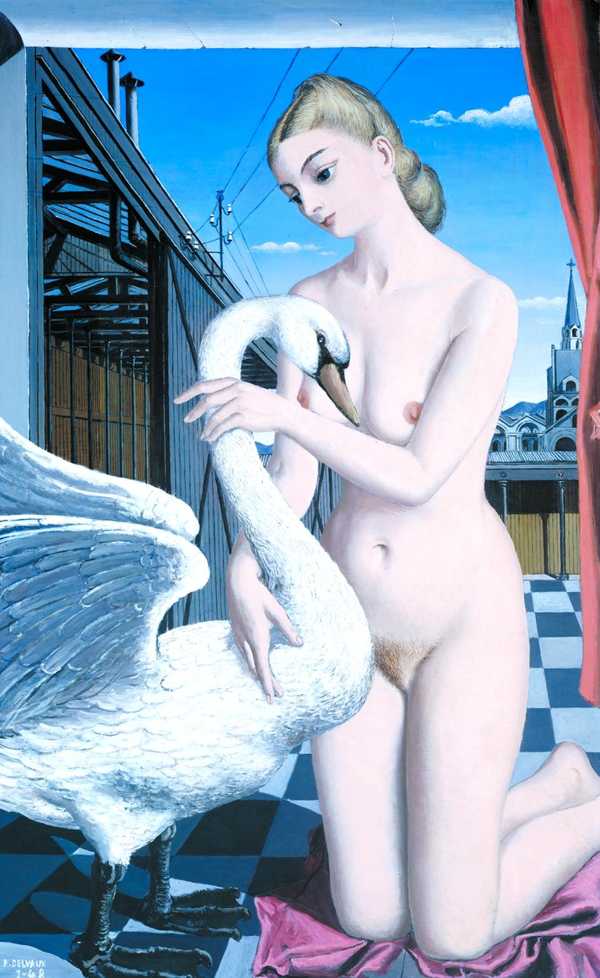
Leda
1948 · Oil paint on board

Composition (The Siesta)
1947 · Ink and watercolor on paper

Two Women
1947 · Pen and black ink with watercolor, over graphite, on white wove paper
Record
Verified by WattsOS- Artist
- Paul Delvaux
- Year
- 1939
- Medium
- Oil on canvas
- Dimensions
- 170.2 × 225.4 cm (67 × 88 3/4 in.)
- Watts ID
- WW-1939-134646
Source
- Collection
- Art Institute of Chicago
- Source
- aic
- Reference
- View at source
- Status
- verified