
Imaginary Portrait of Lautréamont at the Age of Nineteen Obtained According to the Paranoiac-Critical Method
<p>This drawing was reprouced as he frontispiece to Comte de Lautréamont, Isidore Ducasse, <em>Oeuvres complétes: Chants de Maldoror, poésies, lettres</em> (Paris, 1940). Lautréamont was central to the alternative literary genealogy the Surrealists constructed for themselves; his violent, gothic epic, <em>Les Chants de Maldoror</em>, was particularly valued for its extraordinary poetic images, such as the famous metaphor "as beautiful as the chance encounter on a dissecting table of a sewing machine and an umbrella" (<em>Oeuvres complétes</em>, Paris, 1963 ed.,rev. and enl., p. 327), which virtually became the Surrealist's motto.</p> <p>Very little was known about Lautréamont, however. Dalí claimed the portrait was obtained using his "paranoiac-critical" method, which he thought of as a "spontaneous method of irrational knowledge" (Salvador Dalí, <em>Conquest of the Irrational</em>, New York, 1935, p. 15). Usually, this method involved altenative readings of objective phenomena, as in the double images with which he was experimenting at this time (see <a href="https://www.artic.edu/artworks/105527"><em>The Image Disappears</em></a>), which Dalí described as a form of delirium. Here, however, it seems there was no original object of image to provoke the paranoiac associations; the image developed spontaneously by a process of intense concentration of the imagination. Dalí once compared himself to a medium, able to "see" images "that would spring up in my imagination: (Salvador Dalí, <em>The Secret Life of Salvador Dalí</em>, New York, 1961, tr. by Haakon M. Chevalier, p. 220), which he could the situate on the blank page of canvas.</p> <p>The focus on certain details and the emphasis on a single, gazing eye recall other portraits by Dalí of this period, most significantly his self-portraits in <em>Impressions of Africa</em> and related preparatory drawings for this painting of 1938 (Rotterdam, Museum Boymans-van Beuningen; Descharnes and Néret 1994, vol. 1, pld. 671-73). Dalí may also have taken a cue from a mysterious image, a very detailed pencil drawing of a single eye, reproduced in <em>La Révolution surréaliste</em> (2 [Jan. 15, 1925], p. 25) with the caption"Marcel Proust, par Georges Bessiére." Imagery centering on eyes or an eye is ubiquitous in Surrealist art, where it usually stands paradoxically for the idea of internal rather than external vision. Lautrémont was regarder by the Surrealists as one of the great visionaries.</p> <p>Dalí signed this drawing with his own name preceded by that of his companion, Gala, whom he had met in 1929, when she was still married to Paul Eluard. This dual signature reflects the intensity of his relationship with Gala, which led to a degree of identification with her.</p> <p>— Entry, Dawn Ades, <em>Surrealist Art: The Lindy and Edwin Bergman Collection at the Art Institute of Chicago</em>, 1997, p. 104-105.</p>
Catalogue
- Year
- 1937
- Dimensions
- 53.5 × 36.2 cm (21 1/8 × 14 5/16 in.)
- Collection
- Art Institute of Chicago
- Artist
- Salvador Dalí
Artist

Painting
S alvador Dalí, the legendary Spanish Surrealist, became world-famous for his dreamlike masterpieces—most notably The Persistence of Memory—as well as his eccentric persona and boundary-pushing explorations in film, sculpture, fashion, and design. Today, Dalí’s visionary works are celebrated in major museums worldwide and continue to show strong performance at auction, solidifying his status as one of the 20th century’s most influential artists.
Full artist profile →More
More by Salvador Dalí
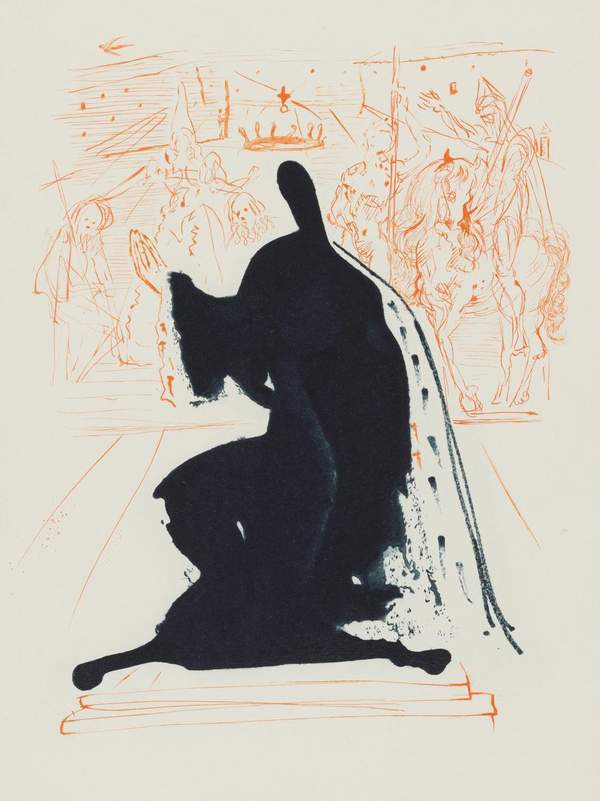
King of Aragon
1973 · Etching and mezzotint on paper

Duel in the sun
1973 · Drypoint and etching with stencil on white wove paper

The Buckingham Fountain
1971 · Etching with color pochoir additions on white wove paper

The Museum of Science and Industry
1971 · Etching with color pochoir additions on white wove paper

The Art Institute
1971 · Etching with color pochoir additions on white wove paper

The Water Tower
1971 · Etching with color pochoir additions on white wove paper
Record
Verified by WattsOS- Artist
- Salvador Dalí
- Year
- 1937
- Dimensions
- 53.5 × 36.2 cm (21 1/8 × 14 5/16 in.)
- Watts ID
- WW-1937-044544
Source
- Collection
- Art Institute of Chicago
- Source
- aic
- Reference
- View at source
- Status
- verified