
Portrait of Otto Mueller
<p>Ernst Ludwig Kirchner’s <em>Portrait of Otto Mueller</em>—with its vibrant, modulated color and penetrating psychological force—is emblematic of the artist’s innovative approach to technique and imagery. A pivotal figure of the German Expressionist movement, Kirchner first met Mueller, also a painter-printmaker, in 1910. Mueller then joined Die Brücke (The Bridge), the group Kirchner had helped found in 1905, which was instrumental in promoting Expressionism. The period between 1915 and 1919 marked Kirchner’s most concentrated and productive phase of work with portrait prints, which he made primarily as large-format woodcuts. In this depiction of Mueller, Kirchner used a spare, planar composition and broad areas of undifferentiated color to depict his subject’s sharp features. He painted on a single block with a brush and varying colors; thus, each print is unique. The cobalt-blue striated forms that emanate from the figure’s right and from the side of his head in this print are abstract representations of the painted bands that decorated Kirchner’s studio wall, against which Mueller posed. These bands, which Kirchner painted himself, exemplify his adoption of motifs and styles from Palauan art of the South Pacific and resonate with Mueller’s own fondness for African-inspired furniture and wall paintings. Indeed, his hieratic, frontal position may suggest his interest in Egyptian art.</p>
Catalogue
- Year
- 1915
- Dimensions
- Image/block: 27.3 × 54.6 cm (10 3/4 × 21 1/2 in.); Sheet: 30.2 × 55 cm (11 15/16 × 21 11/16 in.)
- Collection
- Art Institute of Chicago
- Artist
- Ernst Ludwig Kirchner
Artist

Painting
Painter and graphic artist Ernst Ludwig Kirchner was born in 1880 in Aschaffenberg, Germany. He studied architecture at the Dresden Technische Hochschule (Technical High School), but during his time there decided to devote himself to fine art rather than architecture. By 1905, Kirchner, along with fellow artist friends Erich Heckel and Karl Schmidt-Rottluff, founded Die Brücke (“The Bridge”), an artistic group that sought to “bridge” traditional and classical modes of art making and the avant-garde. Beyond this group, Kirchner found inspiration in the number of post-impressionist exhibitions that were held in Dresden, where he was exposed to the work of such artists as Vincent van Gogh and Edvard Munch—both of whom he would cite as inspirational to the development of his own practice—as well as exhibitions on art from Africa and Oceania.
Full artist profile →More
More by Ernst Ludwig Kirchner
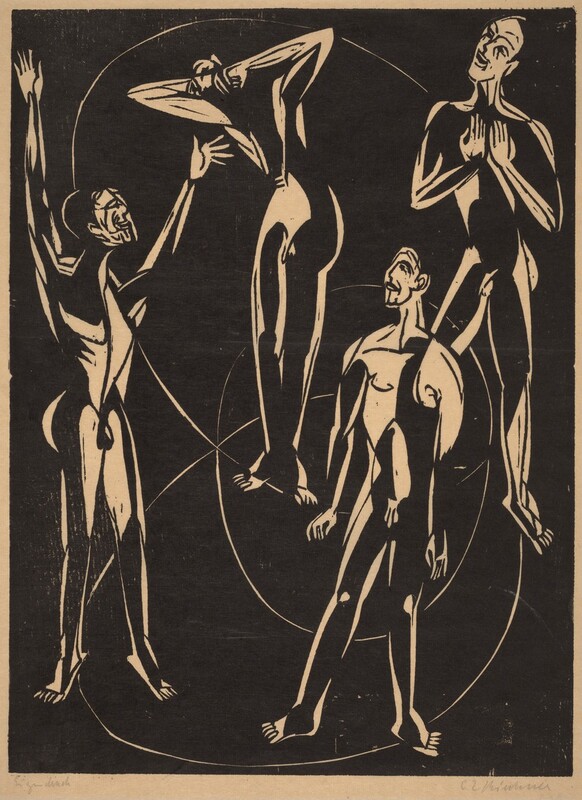
Feelings
1937 · woodcut printed in black
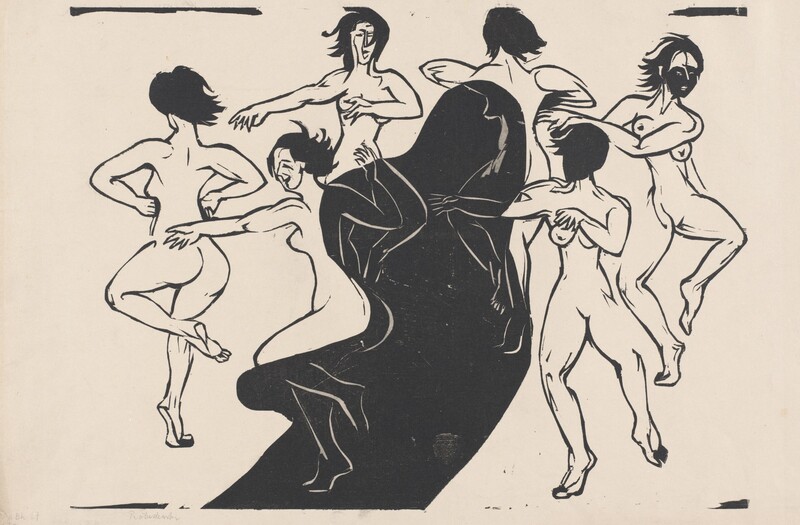
Nudes Dancing around a Shadow
1936 · woodcut printed in black on Japan paper [proof]

Artist and Model (Maler und Modell)
1936 · Woodcut

Two Cats (Zwei Katzen)
1936 · Woodcut
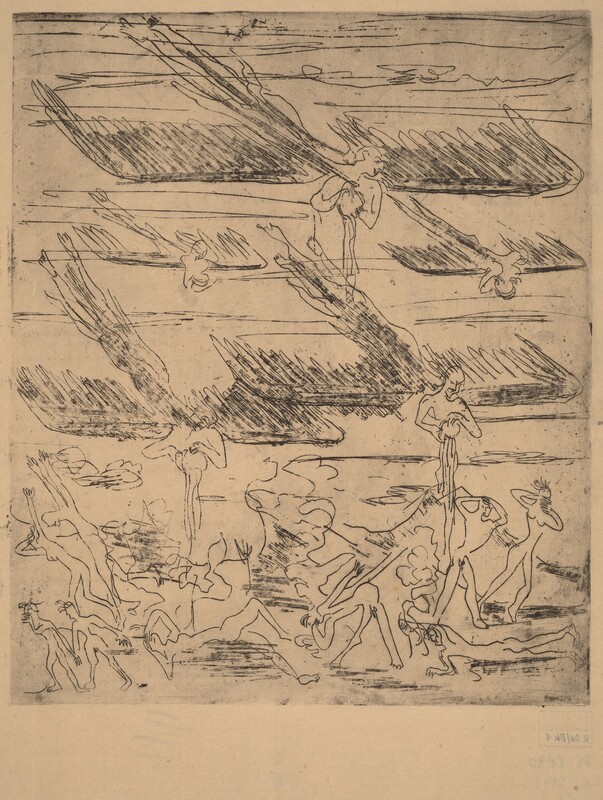
From the Apocalypse
1936 · etching

The Café
1936 · Woodcut from two blocks, in black and green, on white China paper
Record
Verified by WattsOS- Artist
- Ernst Ludwig Kirchner
- Year
- 1915
- Dimensions
- Image/block: 27.3 × 54.6 cm (10 3/4 × 21 1/2 in.); Sheet: 30.2 × 55 cm (11 15/16 × 21 11/16 in.)
- Watts ID
- WW-1915-118530
Source
- Collection
- Art Institute of Chicago
- Source
- aic
- Reference
- View at source
- Status
- verified