
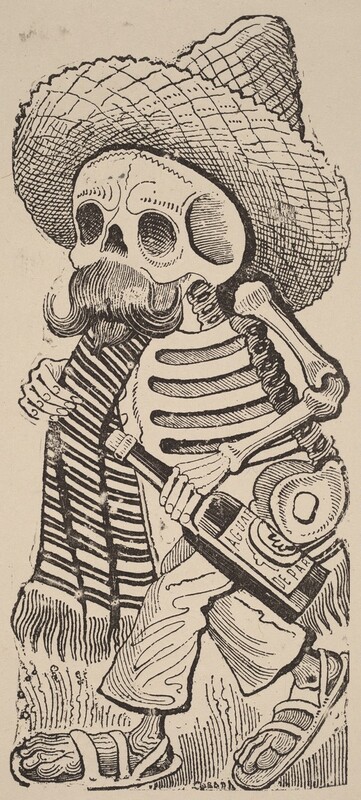
Revolutionary Calavera
<p>José Guadalupe Posada was the most prolific and influential broadside illustrator working in late-19th- and early-20th-century Mexico, and the Taller de Gráfica Popular considered him their artistic forebear and a model of the popular, socially concerned artist. Posada illustrated thousands of colorful, eye-catching broadsides—cheap, ephemeral handbills directed at urban working- and middle-class audiences—that addressed current events, social and political scandals, and curiosities.</p> <p>Posada’s posthumous reputation as an artist committed both to Mexican traditions and to popular political causes largely rests on Day of the Dead broadsides such as this one, which celebrates the gleeful, destructive power of the Mexican Revolution in the form of <em>calaveras</em>, the satirical skeleton figures popularized by Posada. The Taller de Gráfica Popular emulated this tradition, leveraging the critical edge, humor, and manic energy embodied by the <em>calavera</em> figure to address contemporary issues.</p> <p><strong>Español:</strong><br>José Guadalupe Posada fue el ilustrador de hojas volantes más prolífico e influyente del México de finales del siglo XIX y principios del XX. El Taller de Gráfica Popular lo consideró su precursor artístico y modelo del artista popular con consciencia social. Posada ilustró miles de hojas volantes coloridas y llamativas. De bajo costo y efímeras, estas hojas estaban dirigidas a las clases medias y trabajadoras e informaban sobre hechos del momento, escándalos políticos y sociales y rarezas.</p> <p>La fama póstuma de Posada, en cuanto artista comprometido con las tradiciones mexicanas y con las causas políticas populares, descansa mayormente en sus hojas volantes para el Día de Muertos, tales como ésta. Aquí se celebra la jubilosa fuerza destructiva de la Revolución Mexicana en la forma de calaveras, los satíricos esqueletos popularizados por Posada. El Taller de Gráfica Popular replicó esta tradición al utilizar ventajosamente el ángulo crítico, el humor y la energía maniaca representada en la figura de la calavera para abordar temas de su época.</p>
Catalogue
- Year
- 1905
- Dimensions
- 40 × 30 cm (15 3/4 × 11 13/16 in.)
- Collection
- Art Institute of Chicago
- Artist
- José Guadalupe Posada
Artist

Printmaking
José Guadalupe Posada was a Mexican printmaker and illustrator whose satirical engravings and lithographs became the visual language of Mexican popular culture in the late 19th and early 20th centuries. Working primarily in zinc etching and relief printing, he produced thousands of broadsheets, handbills, and book illustrations that merged political commentary with skeletal imagery, most memorably the calaveras that would later define Día de Muertos visual tradition. His prolific output served the Mexican working class and political movements, circulating images of social critique and vernacular wit through affordable prints distributed in markets and streets. Posada's formal inventiveness with line, pattern, and grotesque figuration established visual conventions that would influence Mexican modernism and printmaking internationally.
Full artist profile →More
More by José Guadalupe Posada

Calavera of Francisco Madero, from Calavera Maderista
1944 · Relief etching from a zinc plate on grayish-ivory China paper
Calavera of Francisco Madero, from Calavera Maderista
1944 · relief etching (zinc) on China paper

Calavera of Francisco Madero, from Calavera Maderista
1944 · Relief etching from a zinc plate on grayish-ivory China paper

Calavera of Francisco Madero, from Calavera Maderista
1944 · Relief etching from a zinc plate on grayish-ivory China paper

Calavera of Francisco Madero, from Calavera Maderista
1944 · Relief etching from a zinc plate on ivory Japanese paper

The Medical Consultation (El Consultorio Medical) from 25 Prints of José Guadalupe Posada
1942 · Etching from a portfolio of seventeen engravings and eight etchings
Record
Verified by WattsOS- Artist
- José Guadalupe Posada
- Year
- 1905
- Dimensions
- 40 × 30 cm (15 3/4 × 11 13/16 in.)
- Watts ID
- WW-1905-066146
Source
- Collection
- Art Institute of Chicago
- Source
- aic
- Reference
- View at source
- Status
- verified