
Manxman Piano
<p>A product of the Arts and Crafts movement in England, the Manxman Piano represents an innovative solution to the somewhat awkward form of the upright piano. Motivated by the shoddy results of industrial mass production, the movement advocated the recognition of furniture and decorative arts as works of art. Here the celebrated English architect and designer Mackay Hugh Baillie Scott created an object that is both cleverly functional and aesthetically pleasing. When opened, the lid and doors of the strikingly decorated cabinet act as acoustical sounding boards. Revealed inside is the musical instrument itself, along with a profusion of exquisite handcrafted metalwork, including candleholders fixed to the sides of the case. The overall design, like the keyboard, is a study in contrasts of light and dark; the lower section’s alternating pattern echoes the piano’s keys. A Manxman is an inhabitant of the Isle of Man, and the term derives from Scott’s early residence there. This piano is one of a number executed around 1900 with John Broadwood and Sons of London, who made the musical movements.</p>
Catalogue
- Year
- 1897
- Dimensions
- 128.9 × 143.2 cm (50 3/4 × 56 3/8 in.); With top open: H.: 162.6 cm (64 in.); With one door open: W.: 212.4 cm (83 5/8 in.)
- Collection
- Art Institute of Chicago
Artist

Mackay Hugh Baillie Scott was a British architect and designer whose ornamental interiors and furniture designs epitomized the Arts and Crafts movement of the early twentieth century. Working primarily in domestic architecture, he rejected industrial standardization in favor of hand-crafted decoration, bespoke joinery, and integrated mural schemes that extended design across walls, ceilings, and furnishings as a unified whole. His aesthetic combined medieval revivalism with attenuated Art Nouveau forms, establishing a distinctive house style that influenced British and Continental design practice. Active from the 1890s until his death in 1945, he remains a significant figure in the transition from Victorian ornament to modernist restraint.
Full artist profile →More
More by Mackay Hugh Baillie Scott

Armchair designed for the Dresden Werkstätten Exhibition
1903 · Ebony veneer, inlaid pewter, ivory and mother of pearl

Side Table
1901 · Oak
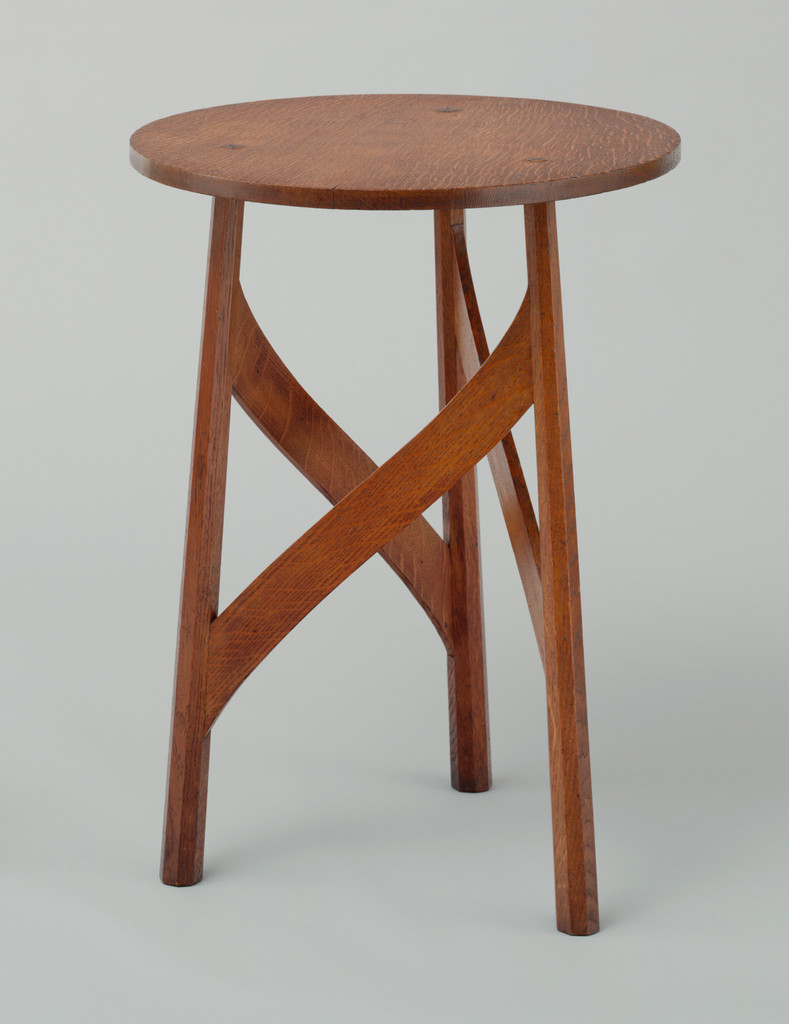
Side Table
1901 · Oak

Work Cabinet
1895 · Mahogany, holly, pewter, bone, ebony, and mother-of-pearl; wrought iron and glass handles
Record
Verified by WattsOS- Year
- 1897
- Dimensions
- 128.9 × 143.2 cm (50 3/4 × 56 3/8 in.); With top open: H.: 162.6 cm (64 in.); With one door open: W.: 212.4 cm (83 5/8 in.)
- Watts ID
- WW-1897-115741
Source
- Collection
- Art Institute of Chicago
- Source
- aic
- Reference
- View at source
- Status
- verified