
Cuirassier with Drawn Sword
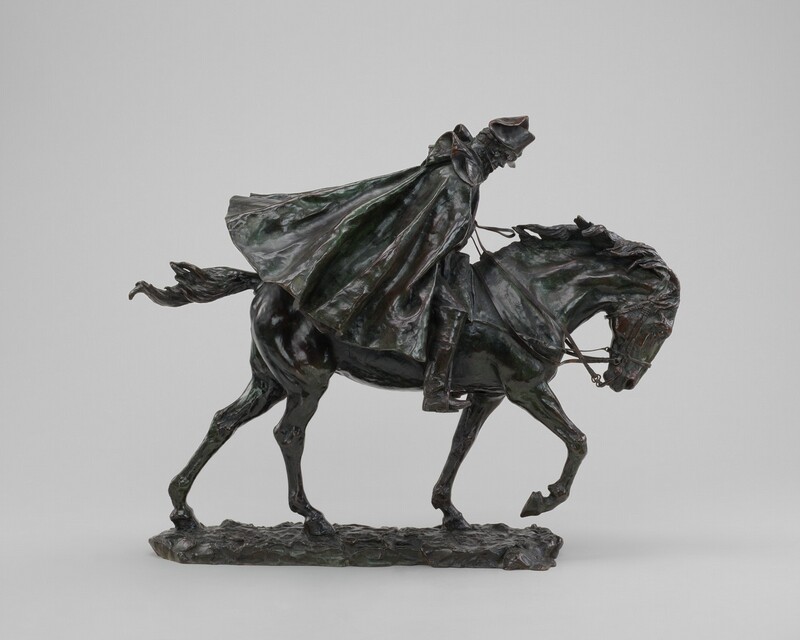
<p>Ernest Meissonier was best known for his exquisitely rendered genre scenes, which drew inspiration from the Dutch masters and were praised for their “microscopic” perfection. But he was also a serious student of military subjects, creating a series of canvases on major episodes in the life of Napoleon I. For his battle scenes, Meissonier fashioned wax sculptures of horses and military figures, such as this cavalryman (known as a cuirassier), which served as a study for the painting <em>1807, Friedland</em> (exhibited in the Salon of 1875). First shown to the public in 1891, Meissonier’s waxes were later cast in bronze to preserve the artist’s conception.</p>
Catalogue
- Year
- 1870
- Medium
- Bronze
- Dimensions
- 49.5 × 62.5 × 21 cm (19 3/4 × 24 5/8 × 8 1/4 in.)
- Collection
- Art Institute of Chicago
Artist

Sculpture
Jean-Louis-Ernest Meissonier was a French academic painter and sculptor. He became famous for his depictions of Napoleon and his military sieges and manoeuvres in paintings acclaimed both for the artist's mastery of fine detail and his assiduous craftsmanship. The English art critic John Ruskin examined his work at length under a magnifying glass, "marvelling at Meissonier's manual dexterity and eye for fascinating minutiae." Meissonier enjoyed great success in his lifetime, becoming, with Gérôme and Cabanel, one of "the three most successful artists of the Second Empire."
Full artist profile →More
More by Jean-Louis-Ernest Meissonier

Bacchus
1887 · Etching and drypoint on ivory wove paper
Horseman in a Storm
1878 · bronze

The Out-Post
1875 · Oil on canvas

The Defense of Paris
1870 · Oil on panel

The Sergeant Reporter
1862 · Etching and drypoint on ivory laid chine

The Sergeant Reporter
1862 · Etching and drypoint on ivory laid chine
Record
Verified by WattsOSSource
- Collection
- Art Institute of Chicago
- Source
- aic
- Reference
- View at source
- Status
- verified