
<p>Among the diverse kinds of gold jewelry featured in Akan chiefly dress are pendants of different sizes and shapes, including human, animal, and abstract designs. Today these objects, cast by the lost-wax technique, are no longer a royal prerogative. They have been documented in the ornamentation of young women undergoing puberty rites and in the possession of persons of wealth and high status. Their current broad geographical distribution also suggests the influence of twentieth century globalism. Indeed, gold pendants are no longer being manufactured exclusively for use in Africa but are made for sale in tourist shops and galleries, and for export. The motif depicted here–a crocodile–is a traditional Akan icon of power. This pendant originates from the Lagoon region of present-day Côte d'Ivoire. It exemplifies the fine technical skill, style, and imagery typical of that area of the rain forest. [See also 1991.390, 1991.391, and 1991.393].</p> <p>–Revised from Nii Otokunor Quarcoopome, “Art of the Akan,” African Art at the Art Institute of Chicago, Museum Studies, vol. 23, no. 2 (1997), pp. 135-147.</p>
Catalogue
- Year
- 1850
- Medium
- Gold
- Dimensions
- 6.4 × 10.2 × 1.3 cm (2 1/2 × 4 × 1/2 in.)
- Collection
- Art Institute of Chicago
- Artist
- Baule
Artist

Baule is an artist whose practice and medium remain to be documented.
Full artist profile →More
More by Baule

Palm Wine Vessel
1925 · Terracotta

Face Mask (Ndoma)
1900 · Wood

Water Container
1900 · Blackened terracotta, wash, and kaolin

Diviner's Belt
1900 · Leather, fur, gourd, shell, and wood
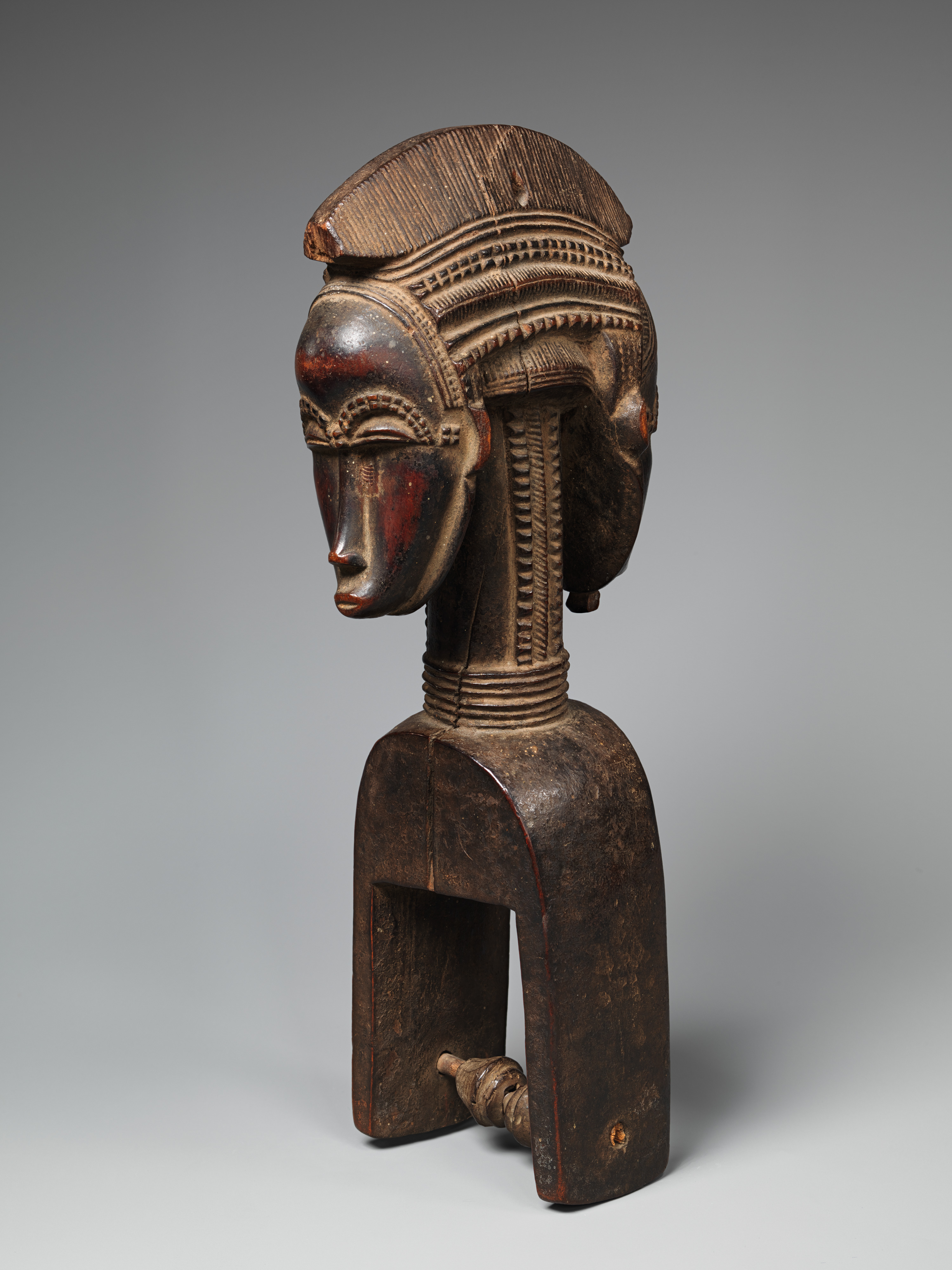
Heddle pulley with opposing faces
1890 · Wood

Dance Staff
1875 · Wood, kaolin, and pigment
Record
Verified by WattsOSSource
- Collection
- Art Institute of Chicago
- Source
- aic
- Reference
- View at source
- Status
- verified