
Kremlin Tower Clock
1912 · rhodonite, silver, enamel, emeralds, sapphires
Overall: 29 x 14.6 cm (11 7/16 x 5 3/4 in.)
Cleveland Museum of Art
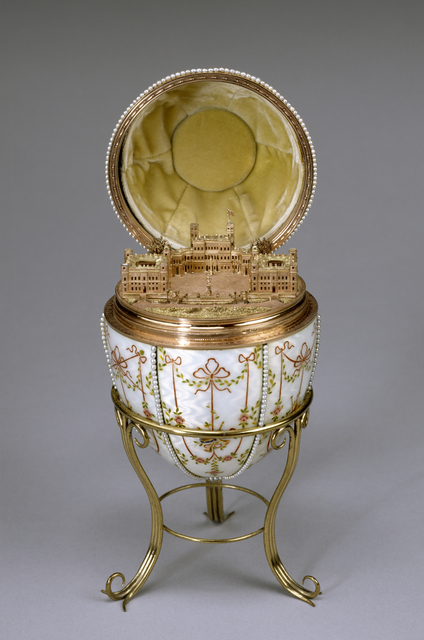
Peter Carl Faberge (1846-1920) took over the House of Faberge in 1870 from his father Carl Gustav Faberge who had founded the firm in 1842. Until 1881, the firm manufactured primarily jewelry for Saint Petersburg's aristocrats and wealthy elite. In 1885 the firm was awarded the coveted imperial warrant as goldsmith to the tsar and began to produce elaborate presentation Easter eggs as a gift for the tsarina from her husband every year. They also produced luxurious accessories, jewelry, and hardstone sculptures. At one point, Faberge employed over 300 workers including 22 workmasters who oversaw the production of the firm's jewelry and precious objects. A branch of the firm opened in Moscow in 1887, specializing in neo-Russian and pan-Slavic motifs in jewelry, silver, and enamel. Other branches followed in Kiev, London, and Odessa as well as new premises in Saint Petersburg. At the onset of the Russian Revolution, Peter Carl Faberge fled the country to Paris then Switzerland, where he died in 1920. His firm was nationalized by the Bolsheviks in 1918.
Source: Artsy · Trust score: 85% · Updated 1mo ago


